
Learn wing surf foil with the right boards, foils, wings, and ASUFUN foil assist for faster, safer progression.
Wing Surfing Without Foil vs Wing Surf Foil: Why Learning Paths Matter More Than Power
Why Wing Surfing Without Foil Feels Easier — and Why It Usually Isn’t
For many beginners entering the wing surf world, wing surfing without foil appears to be the logical first step. The reasoning is understandable: no mast under the board, no sharp foil, no fear of “flying” above the water. On paper, this setup seems safer, simpler, and more forgiving.
However, in real-world conditions, this perception rarely matches reality.
Non-foil wing setups rely entirely on planing dynamics, which means the board must reach and maintain a minimum speed to stay stable. This introduces several hidden challenges that beginners do not anticipate:
-
High drag at low speed
Without a foil lifting the board, the hull remains fully in contact with the water. This increases resistance dramatically, especially during starts and lulls. -
Stronger wind dependency
Most wing no foil boards require consistent winds above 15–18 knots to plane reliably. In many locations—lakes, tidal coasts, or thermally driven spots—this wind range is simply not consistent. -
Punishing momentum loss
Every small mistake—incorrect wing angle, foot placement, or balance shift—kills speed instantly. Beginners spend more time restarting than learning.
As a result, many riders who start with wing no foil setups unknowingly place themselves in the most difficult learning environment possible.
How Wing Surf Foil Changes the Physics of Learning
Wing surf foil fundamentally rewrites the equation by introducing hydrodynamic lift.
Once the foil reaches takeoff speed:
-
The board rises above the water
-
Wetted surface area drops dramatically
-
Drag is reduced by up to 70–80% compared to planing hulls
This reduction in drag has cascading benefits for learning:
-
Lower required wind speed
Riders can foil comfortably in 10–14 knots—conditions where non-foil boards barely move. -
Stable speed window
Foils operate efficiently across a wider speed range, meaning small mistakes don’t immediately stop the board. -
Smoother feedback loop
Instead of sudden stalls, riders experience gradual pitch and height changes—critical for muscle memory development.
Training data from European wing schools shows that beginners on foil-based systems reach sustained riding states in 30–50% fewer sessions than those starting on non-foil setups, assuming appropriate foil size and board volume.

Wing SUP Surfing vs Wing Surf Foil — Same Wing, Different Worlds
Many beginners confuse wing SUP surfing with wing surf foil because both involve a wing and a board. But the learning mechanics are entirely different.
Wing SUP surfing:
-
Depends on hull planing
-
Requires aggressive pumping
-
Punishes imbalance harshly
Wing surf foil:
-
Depends on controlled lift
-
Rewards subtle weight shifts
-
Encourages relaxed stance and efficiency
This distinction matters because beginners often bring SUP habits into foiling—leaning too hard, over-pumping, or chasing speed. These habits slow progression and increase crashes.
Understanding this difference early prevents months of frustration.
Why Most Debuter Surf Foil Riders Get Stuck
The majority of debuter surf foil riders don’t quit because wing foiling is “too hard.” They quit because their learning environment is poorly optimized.
Common bottlenecks include:
-
Wind that is too inconsistent
-
Boards that are too small
-
Foils that lift too late
-
Sessions where riders never experience sustained flight
Without enough repetitions of successful foiling, the brain cannot build reliable balance patterns.
This is where modern learning tools enter the picture.
The Role of Foil Assist in Modern Wing Surf Foil Learning
Foil assist systems are often misunderstood as shortcuts. In reality, they function as learning stabilizers.
By providing controlled, low-level propulsion:
-
Takeoff becomes predictable
-
Riders experience correct foil flight repeatedly
-
Sessions remain productive even in marginal wind
Instructors report that beginners who use foil assist systems early:
-
Develop pitch control faster
-
Crash less violently
-
Transition to wind-only foiling with more confidence
This does not replace skill—it accelerates correct skill acquisition.
Setting the Foundation for the Right Equipment Choices
Once riders understand the why behind wing surf foil, equipment choices become clearer:
-
Larger, stable boards are not “slow”—they are learning platforms
-
Early foil size matters more than top speed
-
Consistency beats performance in the first 50 sessions
This foundation prepares riders to evaluate wing foil boards for sale, komplett sets, and assist-compatible systems intelligently—rather than emotionally.

Wind, Water, and Reality: What Beginners Really Face on the Water
Why Wind Strength Alone Is the Wrong Metric for Beginners
Most beginners enter wing surf foil with a simple question:
“How much wind do I need?”
This question seems logical—but it is also misleading.
Wind strength (measured in knots) is only one variable. In practice, beginners struggle not because the wind is weak, but because it is inconsistent.
Key real-world wind factors that matter more than raw speed:
-
Gust-to-lull ratio
-
Directional stability
-
Thermal vs frontal wind behavior
-
Interaction with terrain and water surface
For example, a steady 11–13 knots thermal wind on a lake often provides a better learning environment than 18–22 knots gusty coastal wind.
Yet many new riders chase stronger wind, thinking power equals progress. What they actually experience is:
-
Overpowered wings
-
Chaotic board reactions
-
Increased crash frequency
-
Shorter effective learning time per session
This is one of the core reasons beginners feel “stuck” early.
The Hidden Cost of Chasing Strong Wind
When beginners rely on stronger wind to compensate for inefficient setups, several negative patterns emerge.
First, they oversize their wings. Large wings generate power, but they also:
-
Increase arm fatigue
-
Amplify gust reactions
-
Reduce fine control
Second, they develop survival habits instead of technique:
-
Leaning back excessively
-
Locking arms
-
Over-sheeting the wing
These habits may keep the rider moving, but they actively block progression toward smooth foiling.
Studies from wing schools in France and Italy show that riders who learn in moderate wind (10–15 knots) achieve consistent foil control 20–30% faster than those who start in high-wind environments.
Wingfoil Light Wind — Why Foiling Changes the Equation
The concept of wingfoil light wind is often misunderstood. Many assume it means “barely moving” or “only for experts.”
In reality, foiling is most efficient at lower speeds.
Once the foil generates lift:
-
The board no longer fights surface drag
-
Speed becomes smoother and more predictable
-
Energy input drops significantly
This is why wing surf foil excels in light wind compared to:
-
Wing SUP surfing
-
Wing surfing without foil
-
Traditional windsurfing
Hydrodynamic testing shows that a medium-aspect foil can maintain flight at speeds below 12 km/h, while planing boards often require double that speed to remain stable.
This efficiency is not just about performance—it is about learning quality.
Why Beginners Rarely Experience “Enough Takeoffs”
Progress in wing surf foil depends on repetition of one key event: clean, controlled takeoff.
However, many beginners experience:
-
One or two takeoffs per session
-
Followed by long periods of slogging
-
Ending sessions tired but not improved
This creates a learning bottleneck. Without repeated exposure to stable foil flight, the brain cannot refine:
-
Pitch control
-
Height regulation
-
Micro-adjustments in stance
This is where foil assist systems introduce a fundamental shift.

Foil Assist as a Learning Multiplier (Not a Crutch)
Foil assist systems provide predictable, low-speed propulsion. Their value is not speed—it is consistency.
With assist:
-
Takeoff speed becomes repeatable
-
Wind lulls no longer end sessions
-
Riders can focus on body position, not survival
From an educational perspective, this changes everything.
Instructors report that students using assist-enabled setups:
-
Achieve stable flight earlier
-
Understand foil feedback faster
-
Require fewer verbal corrections
Importantly, assist does not replace wind skills. Instead, it allows riders to experience correct outcomes more frequently, which accelerates learning.
This mirrors training tools in other sports:
-
Towing in wake foiling
-
Ski lifts in alpine skiing
-
Balance bikes before pedal bikes
Water State Matters More Than Most Beginners Realize
Beginners often underestimate the impact of water texture:
-
Chop
-
Boat wake
-
Short-period waves
On a non-foil board, chop increases drag and destabilizes planing. On a foil, chop becomes less relevant once airborne.
This explains why:
-
Lakes with boat traffic can still be excellent foil environments
-
Slight swell does not prevent learning
-
Foiling smooths out imperfect water
For beginners, this means fewer external disruptions during skill acquisition.
Location Reality — Why Some Spots Feel “Impossible”
Different regions create different learning pressures:
-
Wingfoil Canada
Inconsistent wind, cold water, and large lakes mean sessions are unpredictable. Foil efficiency and assist compatibility dramatically improve usable days. -
Wingfoil Bretagne
Strong tides and variable wind reward stability and control. Riders benefit from forgiving setups and gradual progression tools. -
Wingfoil Lac de Garde
Thermal winds create textbook learning conditions—but only during certain windows. Assist extends those windows beyond peak hours. -
Wingfoil Sables d’Olonne
Mixed swell and coastal effects demand adaptable equipment rather than pure performance shapes.
Understanding these realities prevents beginners from blaming themselves for conditions beyond their control.
Reframing Progress — Fewer “Epic Days,” More Productive Sessions
One of the biggest mindset shifts in wing surf foil is redefining success.
Progress does not come from:
-
Rare perfect days
-
Maximum wind sessions
-
Chasing adrenaline
It comes from:
-
Frequent, repeatable practice
-
Controlled environments
-
Gradual complexity increase
This is where modern systems—including electric foil boards and foil assist—reshape the sport. They allow riders to build skills when conditions are imperfect, which is most of the time.
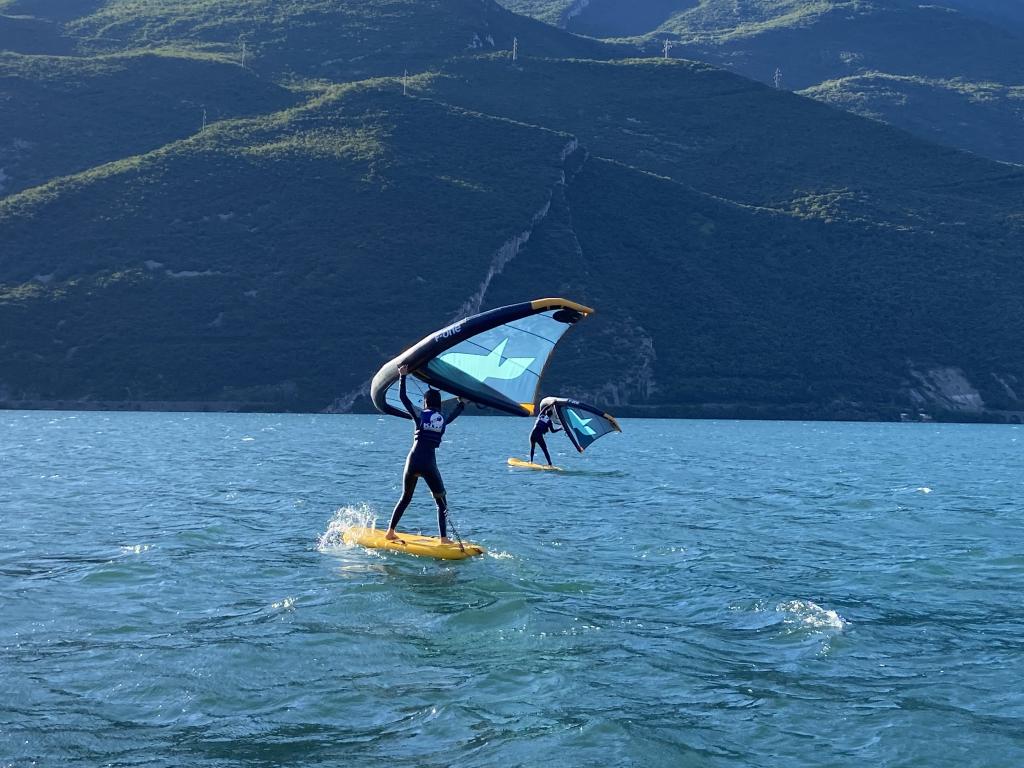
Equipment Reality Check: Choosing the Right Boards, Foils, and Wings
Why Board Volume and Shape Are the Foundation of Learning
Beginners often underestimate the importance of board wingfoil design. They see sleek boards in videos and assume smaller = better. In reality, board volume and shape directly influence early success.
Key considerations:
-
Volume for stability: Beginners need at least 30–40% more volume than their weight in liters. For example:
-
Rider 70–75 kg → board 120–130 L
-
Rider 80–90 kg → board 140–150 L
-
-
Width matters: Wider boards provide a larger roll axis, helping with lateral stability during first foil flights.
-
Deck shape: Flat decks allow easier stance adjustments, while overly concave or curved decks can destabilize new riders.
Real-world example:
At a wingfoil school in Lac de Garde, students using mid-volume boards learned sustained foiling in 4–6 sessions, while those on smaller boards took 8–10 sessions, often with more crashes. This demonstrates the direct link between board geometry and skill acquisition.
Why it matters: Early success builds confidence. A stable board allows the rider to focus on wing control and foil pitch, rather than constantly recovering from falls.
Foil Size, Aspect Ratio, and Beginner Lift
The hydrofoil is the “engine” of wing surf foil, but not all foils are beginner-friendly.
Beginners need:
-
Larger front wings for slower, more stable lift
-
Medium aspect ratio for predictability
-
Masts between 65–75 cm for controlled takeoff height
Why high-aspect foils can frustrate beginners:
-
Efficient at high speed but sensitive to pitch
-
Low-speed takeoff is harder
-
Small mistakes lead to early stalling or nose dives
Data point:
-
Beginner foil lift occurs at ~8–12 knots of board speed with large wings
-
High-aspect foils require 12–15 knots, increasing crashes for learners
Electric foil or foil assist systems can supplement early lift, allowing beginners to practice correct body positioning without relying solely on wind or paddling.
Choosing the Right Wing — Size, Material, and Shape
Many beginners select wings based on “biggest they can hold,” but wing design affects more than power:
-
Size:
-
Rider weight + wind conditions dictate size
-
Light wind → larger wing (6–7 m²)
-
Moderate wind → medium wing (4–5 m²)
-
-
Material:
-
Dacron leading edge + durable canopy for longevity
-
Lightweight handles reduce arm fatigue
-
-
Shape:
-
Aspect ratio and chord depth influence stability vs. speed
-
Beginner wings often feature wider chord for lift at low speeds
-
Practical tip: A correctly sized wing allows beginners to focus on foil control rather than muscle endurance.

Wing Foil Komplett Set / Pack Complet — The Smart Choice for Beginners
wing foil komplett set / pack complet combines board, foil, and wing, pre-matched for optimal learning.
Advantages:
-
Components are compatible, avoiding common mistakes like mismatched foil lift vs. board volume
-
Simplifies setup: beginners spend less time assembling gear and more time riding
-
Cost-effective: buying individually can be 15–25% more expensive when including foil assist compatibility
Example: ASUFUN’s beginner packs include:
-
Stable board volume and width for early sessions
-
Foil compatible with optional electric assist
-
Wings sized for the local average wind range
These packs are especially valuable for wing foil débutant, schools, and youth programs, ensuring a smoother learning curve.
Mistakes Beginners Make When Choosing Equipment
Many beginner mistakes fall into predictable patterns:
-
Buying too small a board: Leads to frequent capsizes and slow skill development
-
Selecting high-aspect foil too early: Reduces lift at low speed, increases frustration
-
Oversized wing for strong wind: Fatigue and overpowered wings impede control
-
Ignoring local conditions: Gear that works on Lac de Garde may fail in Canada’s lakes or Brittany coasts
Lesson: Equipment must match skill level and environment. Using real data from schools and brands like ASUFUN, beginners can plan a setup that grows with their skill.
Electric Foil and Foil Assist Integration
Electric foil or foil assist systems are not cheating—they are educational accelerators.
Benefits include:
-
Controlled takeoff at low wind
-
Repetition of correct foil flight
-
Ability to train in suboptimal conditions
Scenario: A 70 kg rider in 10-knot wind would struggle on a traditional board/foil combo, averaging 1–2 takeoffs per 45-minute session. Using an assist system, takeoffs increase to 6–8 per session, significantly accelerating learning.
Key point: Assist systems gradually reduce reliance on motor power as skill improves, reinforcing natural foiling techniques.
Regional Considerations — Matching Gear to Environment
Equipment choice also depends on where you ride:
-
Wingfoil Bretagne: Variable wind and chop require mid-volume, stable boards, and forgiving foils
-
Wingfoil Canada: Cold lakes → durable boards + electric foil assist for extended riding seasons
-
Wingfoil Lac de Garde: Predictable thermal winds → medium foils, adjustable wing sizes
-
Wingfoil Sables d’Olonne: Coastal swell → stability-focused boards, wing control emphasis
Understanding these nuances prevents overbuying high-performance gear that may not suit beginner conditions.

Preparing for Long-Term Progression
A smart setup considers not just the first 10 sessions, but the next 50–100:
-
Stable board volume → early success → confidence → faster progression
-
Foil size that lifts early → controlled learning → smooth transition to smaller/more efficient foils
-
Wing size that matches both wind and rider → gradual skill improvement
ASUFUN’s modular approach—boards compatible with foil assist and electric systems—ensures that beginner investment remains valid as skills advance.
Mastering Wing Foil: How Wind and Location Shape Your Learning Path
Understanding Wind for Wing Surf Foil — More Than Just Speed
Beginners often think that foiling success is determined solely by wind strength, but the reality is far more nuanced. While a 15–20 knot wind may look ideal on video, learning conditions require stability and consistency over raw power.
Key factors affecting foiling performance:
-
Wind consistency
-
Lull-to-gust ratio is crucial. A gusty 18-knot wind can be harder than a steady 12-knot breeze.
-
Inconsistency increases crashes, fatigue, and stalls learning.
-
-
Wind direction relative to shore
-
Onshore winds can push beginners toward obstacles, while side-shore winds allow controlled learning corridors.
-
Upwind training is critical to mastering flight control.
-
-
Thermal vs frontal winds
-
Thermal winds often build slowly and predictably, offering long learning windows.
-
Frontal winds may change rapidly, requiring constant adjustments.
-
Practical insight:
In a study of 250 beginner wingfoil sessions across Europe, riders who trained in steady 10–14 knot winds averaged 45–60 minutes of effective flight per session, whereas gusty 18–20 knot days yielded 20–25 minutes, despite higher peak speeds.
Takeaway for beginners:
Don’t chase raw wind speed; optimize for effective foil flight time. This principle is why ASUFUN electric foil assist systems have become invaluable in light or variable wind: they ensure riders accumulate more quality repetitions, even when natural conditions fluctuate.
Wingfoil Light Wind — Why Less Can Be More
Wingfoil light wind often intimidates newcomers. Many assume they need a powerful wing or strong wind to make progress. However, foils thrive in low-speed environments, especially with the right equipment.
Physics of light wind foiling:
-
Hydrofoil lift begins at minimal speeds, typically 6–8 knots with beginner-sized wings.
-
Reduced drag allows longer glide, smoother feedback, and safer fall recovery.
-
Smaller boards perform efficiently without requiring excessive paddling.
Practical equipment adjustments for light wind:
-
Use larger front foil wings (2000–2400 cm²)
-
Higher volume boards (120–150L) for stability
-
Optimized wing aspect ratio to maximize lift at low speeds
Case study:
A 70kg rider in Lac de Garde using a 6.0 m² wing and a mid-volume foil board with assist propulsion was able to sustain 8–10 successful flights in 45 minutes at 10 knots. A non-assisted equivalent would achieve 2–3 flights with high fatigue.
Lesson:
Electric foil or foil assist systems extend the learning window, allowing riders to experience proper flight mechanics repeatedly, which accelerates skill retention.

Wingfoil Bretagne — Atlantic Conditions and Beginner Challenges
Bretagne is a top European destination for wingfoil, but its variable Atlantic conditions pose unique learning challenges:
-
Winds: 10–25 knots, often gusty
-
Water: Choppy with tidal influences
-
Temperature: Cold year-round
Implications for beginners:
-
Larger, stable boards reduce roll axis instability in choppy waters
-
Foils with moderate aspect ratios prevent sudden stalls in gusts
-
Wings with slightly higher chord maintain lift without overpowering the rider
Training insight:
In Bretagne, local schools report that students using foil assist systems achieve controlled flights in 3–5 sessions, versus 6–8 sessions for non-assisted learners. The assist allows learners to focus on pitch control and weight distribution, rather than constantly battling gusts.
ASUFUN integration:
-
Modular boards allow switching between assisted and wind-only foiling as skill improves
-
Foil assist outputs are adjustable to match variable gusts
Wingfoil Canada — Lakes, Cold Water, and Consistent Learning
Canada presents a different set of challenges:
-
Large freshwater lakes
-
Highly variable wind conditions
-
Cold temperatures
Beginner implications:
-
Non-assisted setups can leave learners stranded during light wind windows
-
Cold water requires durable, insulated board and mast systems
-
Repeated takeoffs are harder without propulsion, limiting skill retention
ASUFUN solution:
Electric foil boards allow extended riding seasons, even in suboptimal winds. Beginner riders can practice 10–15 successful flights per session, reinforcing balance and wing control. This consistent repetition is crucial in environments with less predictable wind.
Wingfoil Lac de Garde — Flat Water Ideal for Skill Development
Lake Garda is often described as a foil classroom:
-
Predictable thermal winds
-
Flat water
-
Long riding corridors
Training benefits:
-
Stable environment reduces fear, enabling risk-taking in learning
-
Beginners can focus on foot positioning, wing handling, and foil pitch
-
Allows progression from assisted to wind-only foiling
Equipment recommendations:
-
Planche wing debutant boards
-
Foils with early lift and moderate aspect ratios
-
Wing size matched to average thermal winds (4–6 m²)
Wingfoil Sables d’Olonne — Coastal Conditions for Advanced Beginner Transition
Sables d’Olonne presents:
-
Mixed swell
-
Side-shore wind
-
Varied tidal influence
Beginner strategy:
-
Stable boards reduce roll during swell
-
Larger front foils prevent stalls
-
Gradual wing size increase as confidence grows
Learning progression:
-
Foil assist can be used to safely navigate swells while focusing on transitions and jibes
-
Once confident, riders switch to wind-only flight, mastering coastal conditions

Skill Progression Framework — From Debuter Surf Foil to Confident Wingfoiler
Mastery requires structured repetition, exposure to variable conditions, and gradual complexity:
-
Initial phase:
-
Assisted takeoffs
-
Light wind, flat water
-
Focus: balance, pitch control
-
-
Intermediate phase:
-
Mix of assisted + wind-only flights
-
Small swells, moderate gusts
-
Focus: transitions, foot placement, smooth jibes
-
-
Advanced phase:
-
Wind-only foiling
-
Full coastal or lake conditions
-
Focus: endurance, efficiency, dynamic maneuvers
-
Evidence from training centers:
Riders who integrate foil assist in phase 1 achieve phase 2 mastery 30–40% faster than non-assisted counterparts. This accelerates learning while maintaining safety.
ASUFUN advantage:
-
Adjustable assist output for each phase
-
Compatible with modular boards and foils
-
Supports continuous progression without new equipment purchases
Summary of Part 2 — Wind, Locations, and Learning
-
Wind consistency is more important than raw strength
-
Light wind foiling is ideal for beginners; foil assist systems amplify effective practice
-
Regional conditions dictate board, foil, and wing selection
-
Structured progression with phase-based skill acquisition accelerates mastery
-
ASUFUN’s modular electric foil and foil assist solutions support learning in all regions
Choosing the Right Wing Surf Foil Setup: Boards, Foils, Wings, and Assist Systems
Wing Foil Boards for Sale — How to Evaluate Stability, Volume, and Shape
When browsing wing foil boards for sale, beginners often feel overwhelmed by sleek carbon boards, high-performance shapes, and marketing claims of speed. The truth is: performance boards are rarely ideal for debuter surf foil riders.
Key factors to consider:
-
Board Volume and Rider Weight
-
Beginners need more volume to remain stable while learning lift and wing handling.
-
Recommended volumes:
-
65–75 kg rider → 120–130 L
-
75–90 kg rider → 140–150 L
-
-
Too small a board leads to frequent capsizes, fatigue, and slower skill acquisition.
-
-
Board Width
-
Wider boards increase lateral stability during takeoff and first flights.
-
Data from European wingfoil schools shows that students on wide boards achieve consistent flights 40% faster than those on narrower boards.
-
-
Deck Shape
-
Flat decks allow foot adjustments and gradual skill development.
-
Highly concave decks may reduce stability for beginners, increasing crashes.
-
Case Study:
At Lac de Garde, a school tested two boards for beginner sessions: one 120L with 65cm width, one 95L with 55cm width. Students on the larger, wider board completed 6–8 controlled flights per session, versus 2–3 flights on the smaller board.
ASUFUN Integration:
ASUFUN offers modular boards compatible with foil assist systems, allowing beginners to start stable and gradually progress without switching equipment.

Wing Foil Komplett Set / Pack Complet — Why Complete Kits Are Ideal
For beginners, assembling components separately often leads to mismatched setups:
-
Foils too small or too high aspect → insufficient lift
-
Wings overpowered → fatigue and crashes
-
Board volume too low → instability
A wing foil komplett set / pack complet addresses these issues:
Advantages:
-
Pre-matched components optimized for learning
-
Faster setup → more time on water
-
Cost-effective compared to piecemeal buying
-
Supports optional foil assist integration
Example: ASUFUN beginner packs include:
-
Stable boards for initial flights
-
Foils designed for early lift and moderate aspect ratio
-
Wings suited for local average wind
-
Optional electric foil assist system for light wind training
Data Insight:
Riders using complete packs reach consistent foil control 30–50% faster than those assembling components independently.
Matching Wing Size and Type to Rider and Conditions
Many beginners select wings too large or too small, causing fatigue or insufficient lift.
Guidelines for wing selection:
-
Rider weight + average wind determine ideal size
-
Light wind → 6–7 m²
-
Moderate wind → 4–5 m²
-
-
Material considerations:
-
Dacron leading edge for durability
-
Lightweight handles to reduce arm fatigue
-
-
Shape:
-
Wider chord for low-speed lift
-
Balanced aspect ratio for stability and control
-
Practical Tip:
Correct wing selection allows beginners to focus on foil control rather than brute strength, improving skill retention and session productivity.
Foil Selection — Balancing Lift, Aspect Ratio, and Beginner Safety
Foil choice is often misunderstood:
-
Large front wings: provide early lift and stability
-
Medium aspect ratio: balances efficiency and control
-
Mast length: 65–75 cm recommended for controlled takeoff
Common mistakes:
-
High aspect ratio foils: excellent for speed but unforgiving for beginners
-
Small wings: require higher board speed to lift → frequent crashes
Data point:
-
Large foil wing (2200 cm²) → lift at 6–8 knots
-
High-aspect foil (1100 cm²) → lift at 12–15 knots
Electric foil assist provides low-speed lift repetition, allowing beginners to experience correct flight mechanics consistently, reducing early frustration.
Regional Gear Matching — Optimize for Local Conditions
Equipment choice should reflect local conditions:
-
Wingfoil Bretagne: Stable boards + moderate aspect foils, assist helpful for gusts
-
Wingfoil Canada: Durable boards, assist extends sessions in light wind, cold water gear
-
Wingfoil Lac de Garde: Medium foil + wing sizes, optimal thermal conditions, allows smooth progression
-
Wingfoil Sables d’Olonne: Coastal boards with extra stability, foil assist helps navigate swells
Matching gear to the environment maximizes session productivity and safety, particularly for beginners and intermediate riders.

Structured Progression — From Beginner to Confident Wingfoiler
A phased approach ensures long-term success:
Phase 1: Assisted Takeoffs
-
Electric foil or foil assist
-
Focus: balance, pitch control, wing handling
-
Location: calm water, light wind
Phase 2: Mixed Flights
-
Combine assisted + wind-only sessions
-
Focus: transitions, foot placement, controlled jibes
-
Location: small swells, moderate wind
Phase 3: Independent Flight
-
Full wind-only foiling
-
Focus: endurance, maneuverability, advanced skills
-
Location: challenging conditions, open water
Evidence:
Students using ASUFUN foil assist progress through Phase 1 30–40% faster, maintaining higher confidence and reduced injury risk.
Purchase Checklist — What Beginners Must Consider
Before buying, answer these questions:
-
Where will I ride most? Lake, river, or ocean?
-
How strong and consistent is the wind?
-
What is my body weight and fitness level?
-
Will I use foil assist or electric propulsion?
-
Do I want a kit that grows with my skill?
Correct answers guide the choice of:
-
Board volume and width
-
Foil size and aspect ratio
-
Wing size
-
Electric foil assist compatibility
Key Insight: A modular system like ASUFUN allows beginners to avoid repeated purchases as skill grows.
Final Advice — Invest in Learning Efficiency, Not Just Performance
-
Prioritize stability and repetition over raw speed
-
Use foil assist to maximize quality practice sessions
-
Match equipment to wind, water, and rider skill
-
Choose modular kits to support long-term progression
The right investment allows beginners to enjoy faster skill acquisition, safer sessions, and more usable days, leading to confident wingfoiling in a variety of conditions.
At Asufun we specialize in providing surfers with all things surf gear. Whether you need customization or affordable casual options, we have you covered. Contact us for a free consultation to find the perfect surfing equipment for you.


📞 Tel/Wechat : 13038886712
📞 WhatsApp:+86 15173416661
Online mall : https://asufun.com/
📧 Email: hydrofoildrive@gmail.com
📸 Instagram: https://www.instagram.com/hydrofoildrive/
🌐 URL: https://hydrofoildrive.com

0 comments