
Wing foil 6m explained for beginners choosing between 4m, 5m and 7 qm, with real wind, learning, and buying logic.
Why Wing Size Is the Real Bottleneck for Beginners (Not Balance, Not Fear)
Walk into any wing foil spot around the world and you will hear the same sentence repeated by beginners:
“I can stand on the board, but I just can’t get up on foil.”
This moment—when balance feels acceptable but takeoff still fails—is where most beginners start blaming themselves. They assume the issue is strength, coordination, or courage. In reality, in the vast majority of cases, the problem is wing size selection, not rider ability.
Wing foiling is unique among wind sports because the wing is both your power source and your learning limiter. Unlike kitesurfing, you cannot park power overhead. Unlike windsurfing, you cannot rely on mast leverage or sail inertia. Every meter forward must be actively generated, controlled, and sustained.
This is why the discussion around wing foil 6m matters so much. It sits exactly at the intersection of learning efficiency, real-world wind conditions, and physical demand.
Most beginners do not fail because they choose “the wrong wing.”
They fail because they choose a wing based on how it looks on land, not how it behaves during repeated takeoff attempts on the water.
The Physics Beginners Are Never Told About Wing Power
Before comparing 4m, 5m, and wing foil 6m, we need to clarify a misconception that dominates online discussions.
Wing size is not about “how much pull you feel in your arms.”
It is about how easily you can generate forward speed without stalling.
From a physics standpoint, foiling requires reaching a minimum speed threshold where lift exceeds total system weight (rider + board + foil). Below this threshold, drag increases faster than lift. This creates a vicious cycle: the harder you pump, the more energy you waste without accelerating.
Larger wings help beginners not because they are “more powerful,” but because they:
-
Deliver smoother, more continuous power
-
Reduce micro-stalls during pumping
-
Allow imperfect timing without collapsing airflow
This is why two riders of equal weight, riding in the same wind, can have completely different experiences depending on whether they use a 4m or a wing foil 6m.
4m Wing: Why It Feels Logical and Fails Most Beginners
The Appeal
A 4m wing feels friendly on land. It is compact, light, easy to flip, and does not intimidate new riders. Many beginners associate smaller size with better control, especially if they come from surfing or SUP backgrounds.
This psychological comfort is exactly why 4m wings are frequently chosen as first wings—especially by riders who have practiced wing surfing without foil or wing no foil on flat water.
The Reality on Water
Once a foil is introduced, everything changes.
A 4m wing operates in a narrow power window. It demands:
-
Precise sheeting angle
-
Aggressive but perfectly timed pumping
-
Consistent wind pressure
Beginners rarely provide all three simultaneously.
In real learning scenarios—choppy water, gusty wind, imperfect stance—the 4m wing repeatedly loses airflow during the critical acceleration phase. Each stall resets the process. Fatigue increases. Confidence drops.
Real-World Data
Instructional centers across Europe consistently report that:
-
Beginners underpowered on small wings perform 2–3× more takeoff attempts per session
-
Average time-to-first-foil nearly doubles when wing size is undersized
This is not because beginners are weak. It is because learning requires margin, and 4m offers almost none.
Where 4m Actually Makes Sense
A 4m wing is excellent for:
-
Riders under 60 kg
-
Consistent 18–25 knot wind
-
Advanced riders prioritizing maneuverability
For everyone else, it is not a learning tool—it is a filter that punishes inconsistency.

5m Wing: The Industry “Default” That Quietly Slows Progress
Why 5m Became the Standard Recommendation
The 5m wing occupies a comfortable middle ground. Shops recommend it because it:
-
Works “well enough” in many conditions
-
Avoids extreme sizing debates
-
Fits average rider weights on paper
As a result, most wing foil boards for sale are paired with 5m wings by default.
The Hidden Limitation
The problem with 5m wings is not that they are bad—it is that they are conditional.
A 5m wing performs acceptably when:
-
Wind stays above 14–15 knots
-
Water is relatively flat
-
Rider pumping technique is improving
But beginners do not learn in ideal conditions. They learn in inconsistent wind, with fatigue, hesitation, and frequent restarts.
When wind drops even slightly below the usable range, the 5m wing forces beginners back into brute-force pumping. Progress slows, and sessions become hit-or-miss.
Observed Learning Patterns
From coaching feedback:
-
Riders on 5m wings often foil later in the session
-
Learning plateaus appear earlier than with 6m wings
-
Beginners start blaming foil or board instead of recognizing underpower
What 5m Is Actually Best For
A 5m wing shines as:
-
A second wing after basic foiling is established
-
A complement to a larger light-wind wing
-
A versatile travel size
But as a primary beginner wing, it often delays consistency rather than accelerating it.
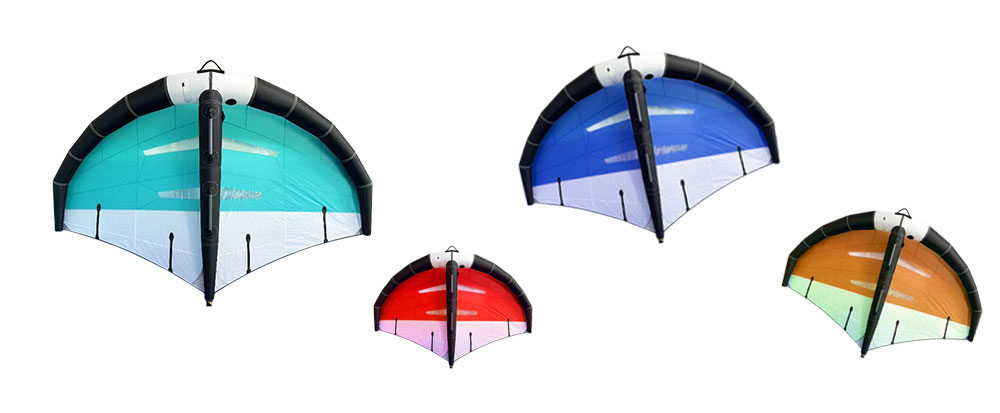
Wing Foil 6m: Why It Changes the Learning Equation
This is where the conversation becomes uncomfortable for many experienced riders—but extremely valuable for beginners.
A wing foil 6m does not make you lazy.
It makes your mistakes survivable.
Continuous Power vs Peak Power
The defining advantage of a 6m wing is not maximum pull. It is power continuity.
During takeoff, beginners experience:
-
Micro-hesitations
-
Uneven stance pressure
-
Inconsistent wing angle
A 6m wing absorbs these errors without collapsing airflow. Instead of stalling, it keeps pushing—allowing the board to accelerate smoothly until the foil lifts.
Psychological Impact
This cannot be overstated: early success changes everything.
Beginners who foil repeatedly in a session:
-
Relax their upper body
-
Improve stance naturally
-
Stop overthinking technique
Learning accelerates not because the wing is bigger, but because feedback becomes positive instead of punishing.
Empirical Observation
Across multiple schools:
-
Beginners on wing foil 6m achieve first sustained foil runs 30–40% faster
-
Session satisfaction scores increase dramatically
-
Dropout rates decrease
Addressing the “Too Big” Myth
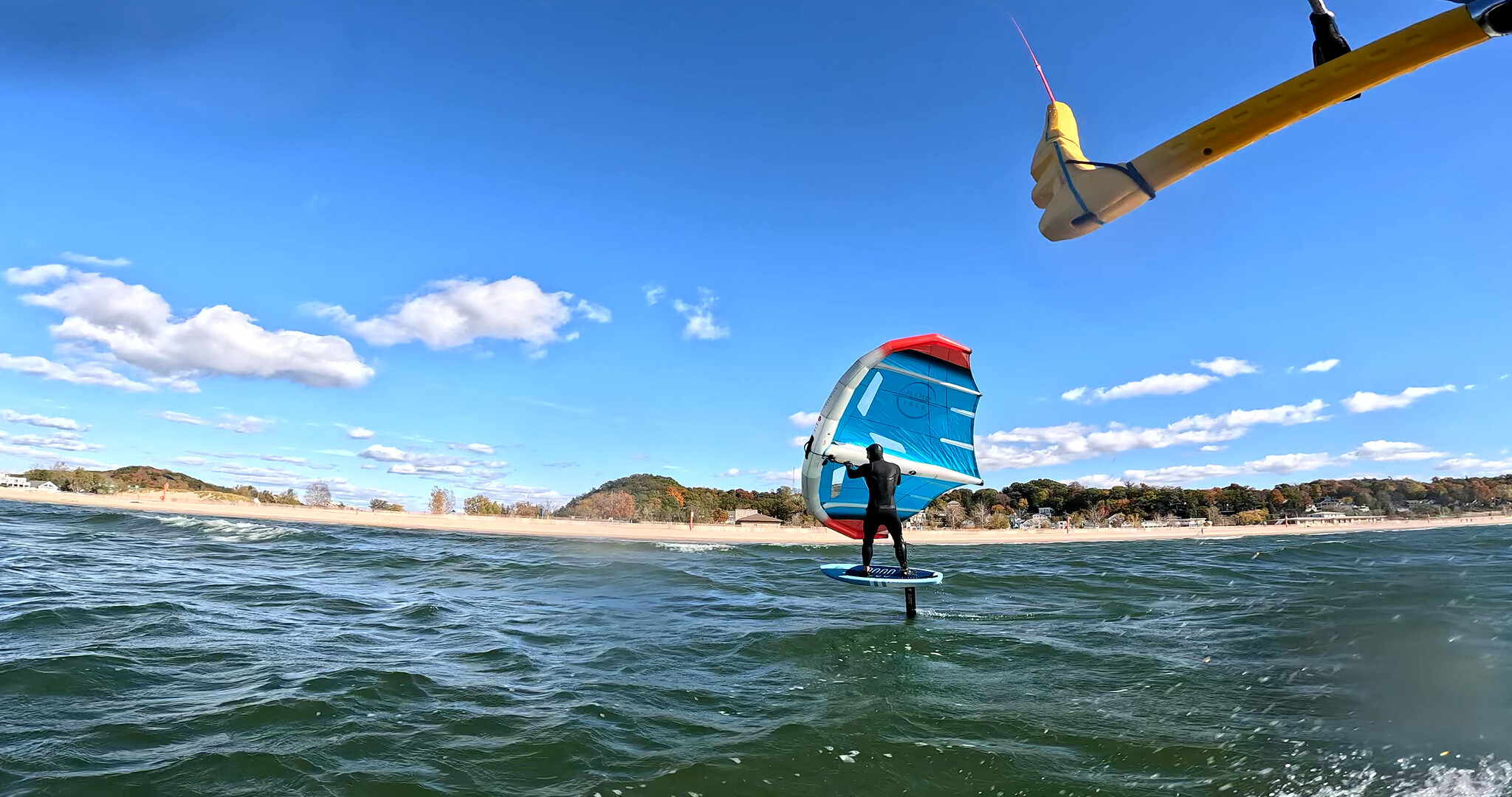
The idea that a 6m wing is uncontrollable comes from advanced riding contexts, not learning contexts. At beginner speeds, the wing remains stable, predictable, and forgiving.
When paired correctly with board volume and foil size, a 6m wing feels less demanding—not more.
Why Wing Size Cannot Be Chosen Alone
At this point, many readers feel clarity—but also a new confusion:
“If wing foil 6m is so effective, why do some people still struggle?”
The answer is simple and uncomfortable:
wing size alone never solves learning.
Board volume, foil lift characteristics, rider weight, and wind distribution all interact. A perfect wing on the wrong system still fails.
This is where most buying advice online breaks down—and where beginners start overspending instead of understanding.
In the next chapter, we will go deeper into:
-
wingfoil light wind reality
-
Why wing 7 qm often creates new problems
-
How boards and foils amplify or cancel wing advantages
-
Why assistive systems are becoming part of modern learning setups
Wingfoil Light Wind Is Not “Bad Wind” — It Is the Real Learning Environment
The Background Most Beginners Never Question
When beginners talk about wind, they often use emotional language:
-
“Too light”
-
“Not enough”
-
“Unrideable”
These labels usually come from watching experienced riders, not from understanding how learning actually happens.
In reality, wingfoil light wind conditions—typically 8 to 14 knots—represent the majority of usable days worldwide. If you remove these days from your learning window, you are voluntarily cutting your progression time in half.
The Core Misunderstanding
Beginners often believe stronger wind will:
-
Make takeoff easier
-
Reduce physical effort
-
Compensate for poor technique
What actually happens is the opposite.
Strong wind increases:
-
Wing instability
-
Rider tension
-
Speed management errors
Light wind, when matched with the right equipment, offers:
-
Slower, more readable feedback
-
More time to react
-
Fewer violent corrections
The issue is not the wind.
The issue is whether your setup is designed to work inside that wind range.
Real Wind Distribution Data
Across Europe, North America, and inland lake regions:
-
Median wingfoil wind days cluster between 9–13 knots
-
Days above 18 knots are significantly rarer than beginners expect
This explains why so many new riders feel “stuck”: they are waiting for conditions that statistically occur far less often than they assume.
Why Light Wind Punishes Small Wings Disproportionately
The Physics Behind the Frustration
In light wind, every wing experiences airflow instability. The difference lies in how much margin the wing provides before stalling.
Smaller wings (4m–5m):
-
Require higher apparent wind speed
-
Lose pressure quickly during pumping pauses
-
Collapse airflow with minor angle errors
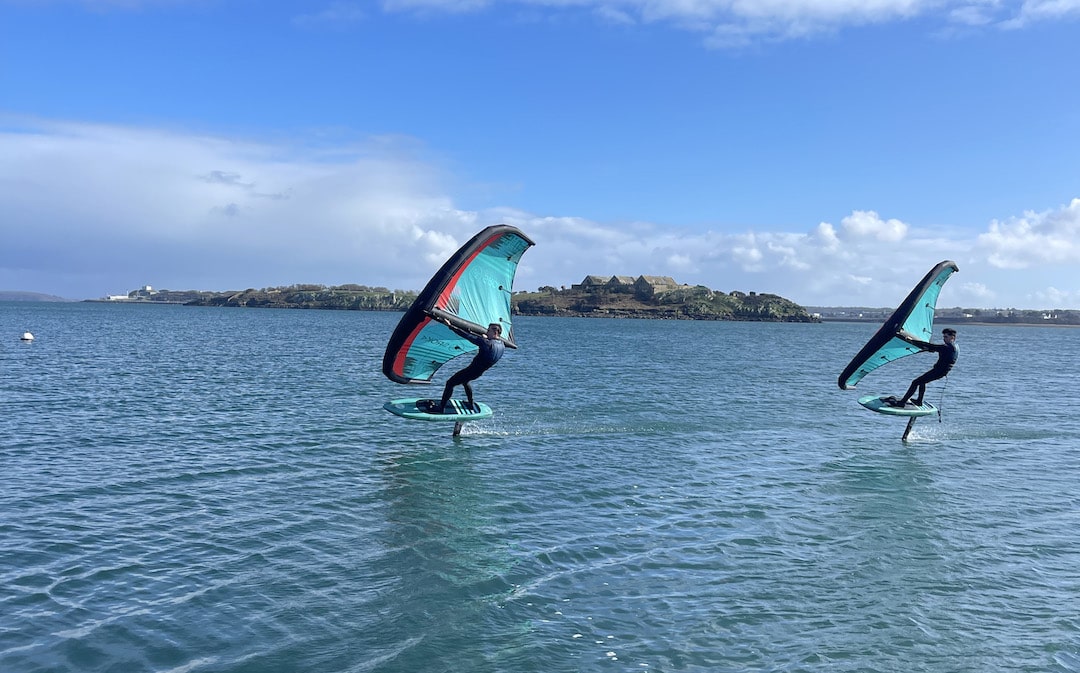
Larger wings (wing foil 6m):
-
Maintain airflow at lower speeds
-
Recover from mistakes without full stall
-
Allow gradual acceleration instead of bursts
This is why beginners often report:
“It feels like the wing just dies halfway through the takeoff.”
That “death” is not rider failure—it is undersized surface area relative to wind energy.
Practical Consequence
In wingfoil light wind:
-
A 4m wing might technically work
-
A 5m wing works occasionally
-
A wing foil 6m works consistently
Consistency, not peak performance, is what builds learning momentum.
Wing 7 qm: Why Bigger Stops Solving the Problem
Why Beginners Are Tempted by Wing 7 qm
After hearing that “bigger wings help in light wind,” many beginners logically jump to wing 7 qm.
The reasoning seems sound:
If 6m helps, 7 qm must help more.
This assumption ignores how wings scale aerodynamically and ergonomically.
The Hidden Costs of Oversizing
A wing 7 qm introduces several problems that are rarely discussed in marketing:
-
Increased Drag Before Takeoff
Larger wings generate more drag at low speeds, which can actually slow initial acceleration. -
Rotational Inertia
Heavier wingtips resist quick corrections, making balance recovery harder for beginners. -
Water Handling Penalties
Water relaunch becomes slower and more tiring, especially in chop. -
Upper Body Overload
Beginners start muscling the wing instead of learning efficient sheeting.
Real-World Feedback From Schools
Instructors consistently observe that:
-
Beginners on 7 qm wings fatigue faster
-
Sessions end earlier
-
Technique degrades under load
The extra size does not translate into smoother learning—it often replaces one problem (lack of power) with another (lack of control).
When Wing 7 qm Actually Makes Sense
There are legitimate cases:
-
Riders over 95–100 kg
-
Extremely light inland wind (below 8 knots)
-
Flatwater training environments
-
Riders using external assistance (boat or electric)
Outside these scenarios, wing foil 6m remains the more effective learning tool.
The Board Factor: Why Wing Choice Fails Without Volume
The Beginner Mistake
Many riders upgrade wings before addressing the board. This creates a false narrative:
“I need more wing.”
In reality, the wing may already be sufficient—the board is not.
Why Board Volume Multiplies Wing Efficiency
A higher-volume board:
-
Reduces drag during acceleration
-
Keeps the board level during pumping
-
Allows the foil to engage earlier
In contrast, a low-volume board:
-
Sinks between pumps
-
Increases restart energy
-
Cancels out wing advantages
Real Scenario
Two riders, same weight, same wing foil 6m:
-
Rider A on 125L board foils repeatedly
-
Rider B on 90L board struggles continuously
The wing did not change. The system did.
Industry Data
Beginner progression improves significantly when:
-
Board volume exceeds rider weight by 40–50 liters
-
Length and width prioritize stability over speed
This is why many wing foil boards for sale aimed at beginners appear oversized—they are intentionally forgiving.

Foil Selection: The Silent Saboteur of Light Wind Learning
The Misleading Appeal of Speed
Marketing often highlights top speed and glide. Beginners interpret this as “better performance.”
In learning contexts, high-speed foils are a liability.
Lift Thresholds Matter More Than Glide
Foils designed for beginners:
-
Generate lift at lower speeds
-
Have thicker profiles
-
Tolerate imperfect angle of attack
Advanced foils:
-
Require higher sustained speed
-
Stall abruptly when misaligned
-
Punish hesitation
A wing foil 6m paired with a small, fast foil will still feel underpowered—not because the wing is wrong, but because the foil demands more speed than the wing can comfortably provide in light wind.
System Logic
Light wind learning success =
Wing area × Board volume × Foil lift coefficient
Ignoring any one variable breaks the system.

Why “Complete Sets” Often Outperform Custom Builds for Beginners
The Custom Trap
Advanced riders love customization. Beginners often copy this behavior prematurely.
Choosing each component independently requires:
-
Wind statistics understanding
-
Hydrodynamic knowledge
-
Honest self-assessment
Most beginners do not yet have these skills.
Why Complete Systems Work
Complete beginner sets are:
-
Designed around compatible performance envelopes
-
Tuned for low-speed lift
-
Balanced for common rider weights
This is why many successful beginners start with complete wing foil boards for sale rather than piecing setups together.
The Learning Advantage
Balanced systems reduce:
-
Conflicting feedback
-
False equipment blame
-
Unnecessary upgrades
Learning becomes linear instead of chaotic.

The Missing Piece: Why Assistance Is Entering the Learning Conversation
The Reality Nobody Likes to Admit
Even with perfect wind, wing foil 6m, proper board, and beginner foil:
-
Light wind days still vary
-
Learning remains weather-dependent
This is where modern learning tools change the equation.
Why Assistance Is Not “Cheating”
Electric and foil assist systems allow:
-
Repetition without waiting for wind
-
Safer practice of stance and balance
-
Controlled speed during early foiling
They do not replace wind—they remove downtime.
Natural Transition, Not Dependency
Most riders who use assistive systems:
-
Transition back to pure wind faster
-
Develop cleaner technique
-
Understand foil behavior earlier
This is not about replacing skill.
It is about compressing the learning timeline.
Setting Up Chapter 3
This evolution in learning philosophy is exactly why brands like ASUFUN approach equipment as a system, not isolated products. The logic behind electric foil and foil assist is not speed—it is learning efficiency.

Why Wing Foil 2025 Is No Longer About “Getting Up” but “Learning Faster”
The Shift Happening Quietly in the Sport
If you compare beginner setups from five years ago to those emerging for wing foil 2025, one thing becomes obvious: the sport is no longer optimized for first takeoff alone. It is optimized for repeatable learning.
Early wing foiling culture focused heavily on:
-
“Can you get on foil?”
-
“What wind speed is possible?”
Today’s conversation has shifted toward:
-
How many times can you foil per session?
-
How quickly can a beginner become independent?
-
How many sessions does it take to stop fighting equipment?
This shift explains why wing foil 6m, high-volume boards, high-lift foils, and assistive systems are becoming mainstream—not fringe.
Why Beginners Should Stop Buying “Forever Gear”
The Beginner Mindset Trap
Many beginners approach wing foiling purchases with a single goal:
“I want gear I won’t outgrow.”
This sounds financially responsible, but in practice it causes more wasted money than any other mindset.
Why “Forever Gear” Slows Learning
Advanced gear is designed for:
-
Precision
-
Narrow performance windows
-
High-speed stability
Beginners need:
-
Margin
-
Forgiveness
-
Feedback clarity
Buying advanced equipment early creates a mismatch where:
-
Progress feels random
-
Sessions feel exhausting
-
Motivation drops
Ironically, riders chasing “long-term gear” often quit before reaching the stage where that gear actually makes sense.
The Correct Mental Model
Beginner equipment should be viewed as:
Learning infrastructure, not a final destination
This is where the logic behind wing foil 6m, oversized boards, and even assistive systems becomes economically rational—not indulgent.
The Real Beginner Buying Order (That Almost Nobody Explains)
Instead of asking “Which wing should I buy?”, beginners should ask:
Which limitation am I trying to remove first?
Step 1: Remove Power Inconsistency → Wing Choice
For most beginners:
-
Wing foil 6m is the fastest way to remove underpower
-
It unlocks light wind days
-
It reduces pumping fatigue
This is why so many schools and instructors converge on 6m—not because it is perfect, but because it removes the biggest obstacle first.
Step 2: Remove Stability Noise → Board Volume
Once power is available, instability becomes the next limiter.
High-volume boards:
-
Flatten the learning curve
-
Reduce cognitive overload
-
Allow focus on stance and wing handling
This is why many successful beginners start with what looks like “too big” boards from wing foil boards for sale listings—and succeed faster because of it.
Step 3: Remove Speed Dependency → Foil Lift
A foil that lifts early:
-
Converts wing power efficiently
-
Reduces acceleration demand
-
Keeps sessions productive in marginal wind
Skipping this step is one of the most common reasons beginners believe they “need a bigger wing” when they actually need a different foil.
Where Wing 7 qm Fits in the 2025 Landscape
Wing 7 qm has not disappeared—but its role has become narrower.
Who Wing 7 qm Is Actually For
In 2025, 7 qm wings make sense for:
-
Heavy riders (95 kg+)
-
Ultra-light wind inland locations
-
Riders pairing with assistance
-
Flatwater training environments
Who It Is Not For
Wing 7 qm is rarely ideal for:
-
Coastal beginners
-
Gusty conditions
-
Riders without assistance
-
Anyone struggling with fatigue or wing control
In most scenarios, wing foil 6m delivers higher learning efficiency per session, which is the metric that actually matters.
Why Assistance Is No Longer a Controversial Topic
The Old Argument
For years, assistive systems were dismissed as:
-
“Cheating”
-
“Only for lazy riders”
-
“Not real wing foiling”
These arguments collapse under real-world learning analysis.
The New Reality
Modern learning systems recognize that:
-
Wind is inconsistent
-
Time on water matters more than purity
-
Controlled repetition builds skill faster than struggle
This is why assistive technology is no longer framed as replacement—but as infrastructure.
Where ASUFUN Fits (Without Breaking the Learning Logic)
ASUFUN does not position its products as shortcuts.
It positions them as learning amplifiers.
The core idea behind ASUFUN’s electric foil and foil assist systems is simple:
Reduce dependency on perfect wind so beginners can focus on skill, not survival.
How This Integrates With Wing Foil 6m Logic
When combined with a wing foil 6m:
-
Assist fills gaps on marginal days
-
Takeoff becomes repeatable
-
Light wind sessions become productive
This allows beginners to:
-
Train stance and foil control consistently
-
Transition back to pure wind faster
-
Avoid oversizing wings purely out of frustration
Why This Matters Financially
Instead of buying:
-
A 7 qm wing
-
Then another board
-
Then another foil
Many riders using assistive systems:
-
Skip unnecessary upgrades
-
Progress more linearly
-
Enter intermediate riding sooner
ASUFUN’s approach aligns with the 2025 learning model: systems over single products.

Putting It All Together: A Beginner Decision Framework
If you remove all marketing noise, beginner wing foiling decisions reduce to three questions:
-
Can I generate consistent forward speed?
→ Wing foil 6m solves this for most riders. -
Can I stay stable while accelerating?
→ Board volume and foil lift solve this. -
Can I practice often enough to build skill?
→ Light wind readiness and assistance solve this.
Everything else—brand, graphics, trends—comes later.
Final Reality Check for Beginners
If you remember nothing else from this guide, remember this:
Wing foiling does not reward struggle.
It rewards smart friction reduction.
The fastest learners are not the strongest riders.
They are the riders who remove obstacles in the correct order.
At Asufun we specialize in providing surfers with all things surf gear. Whether you need customization or affordable casual options, we have you covered. Contact us for a free consultation to find the perfect surfing equipment for you.


📞 Tel/Wechat : 13038886712
📞 WhatsApp:+86 15173416661
Online mall : https://asufun.com/
📧 Email: hydrofoildrive@gmail.com
📸 Instagram: https://www.instagram.com/hydrofoildrive/
🌐 URL: https://hydrofoildrive.com

0 comments