
Master tack wing foil techniques with deep insights into balance, wind control, and progression toward gybe and 360 skills.
Introduction: Why Tack Wing Foil Is the Real Turning Point
For many wing foilers, the learning curve feels smooth at first. You progress from kneeling to standing, from short glides to sustained flights, and soon you are comfortably riding on foil. But then progress slows—sometimes abruptly. You can ride, but you cannot fully control your direction, your upwind angle, or your transitions.
This is where tack wing foil becomes the defining skill.
Unlike the gybe, which follows the wind and rewards speed, a tack forces you to confront the true fundamentals of wing foiling: wind management, foil efficiency, board trim, and body mechanics. It is the moment where wing foiling stops being reactive and becomes intentional.
Most riders do not fail at tack wing foil because they lack courage or fitness. They fail because:
-
Their foil setup is not optimized for slow-speed lift
-
Their wing handling creates power spikes instead of controlled pull
-
Their body movement disrupts foil balance at the most critical moment
-
They misunderstand why the tack exists in the first place
This article is written for riders who already foil consistently and want to break into advanced control. It is not a list of quick tips. It is a deep, connected explanation of how tack wing foil works, why it matters, and how it links directly to water start wingfoil efficiency, changement de pied wingfoil, remonter au vent wing foil performance, and eventually foil tack, 360 wingfoil, and style-specific riding such as wing foil freeride, wingfoil wave, and wingfoil freestyle.
What Exactly Is a Tack in Wing Foiling?
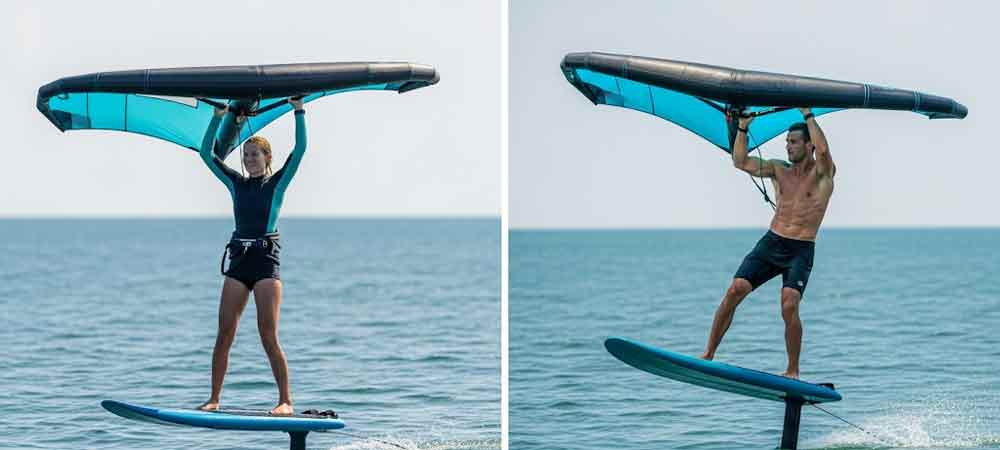
In simple terms, a tack is an upwind direction change where the board passes through the eye of the wind. In practice, it is one of the most technically demanding movements in wing foiling because it combines three unstable moments into one continuous sequence:
-
Loss of apparent wind as you head upwind
-
Temporary reduction in foil lift due to speed drop
-
Body repositioning (and often foot switching) while airborne on foil
Unlike a gybe, where centrifugal force and wind pressure help stabilize the board, a tack removes external support. The rider must create stability internally—through posture, timing, and equipment choice.
This is why tack wing foil success is such a strong indicator of overall riding competence.
Tack Wing Foil vs Gybe: Functional, Not Stylistic
Many riders ask whether they should focus on gybes first and postpone tacks. While this approach can work short-term, it often creates long-term limitations.
Gybe advantages:
-
Uses wind assistance
-
Requires less foil lift at low speed
-
Easier for heavier riders or large wings
Tack advantages:
-
Essential for remonter au vent wing foil performance
-
Critical in confined spots or wave environments
-
Forms the technical foundation for foil tack and 360 wingfoil
-
Reduces dependency on high speed
Advanced riders do not choose between tack and gybe—they deploy both strategically. However, without a functional tack, your riding remains directionally limited, especially in lighter winds or variable conditions.
The Three Pillars of a Successful Tack Wing Foil
Every successful tack—regardless of style or conditions—relies on three interdependent systems. Ignoring any one of them leads to failure.
1. Foil Lift at Low Speed
A tack happens at the slowest moment of your ride. This means your foil must generate stable lift at reduced water flow.
Key variables include:
-
Front wing surface area
-
Profile thickness
-
Aspect ratio
-
Stabilizer angle
High-aspect race foils may perform exceptionally well at speed but punish mistakes during tacks. For riders prioritizing progression, mid-aspect freeride foils often provide a more forgiving lift curve.
This is one reason why many experienced riders transitioning into consistent tack wing foil choose modular setups that allow fine-tuning of mast position, stabilizer shims, and wing combinations instead of fixed, one-size configurations.
2. Wing Power Modulation (Not Maximum Power)
One of the most common mistakes is over-sheeting the wing just before initiating the tack.
In reality, a tack requires:
-
Smooth, progressive power delivery
-
A stable wing overhead position
-
Minimal vertical oscillation
Power spikes create foil breaches. Under-power causes stall. The goal is predictability, not force.
Experienced riders often describe the wing during a tack as “quiet.” That quietness comes from understanding wind angle rather than fighting it.
3. Body Movement Path
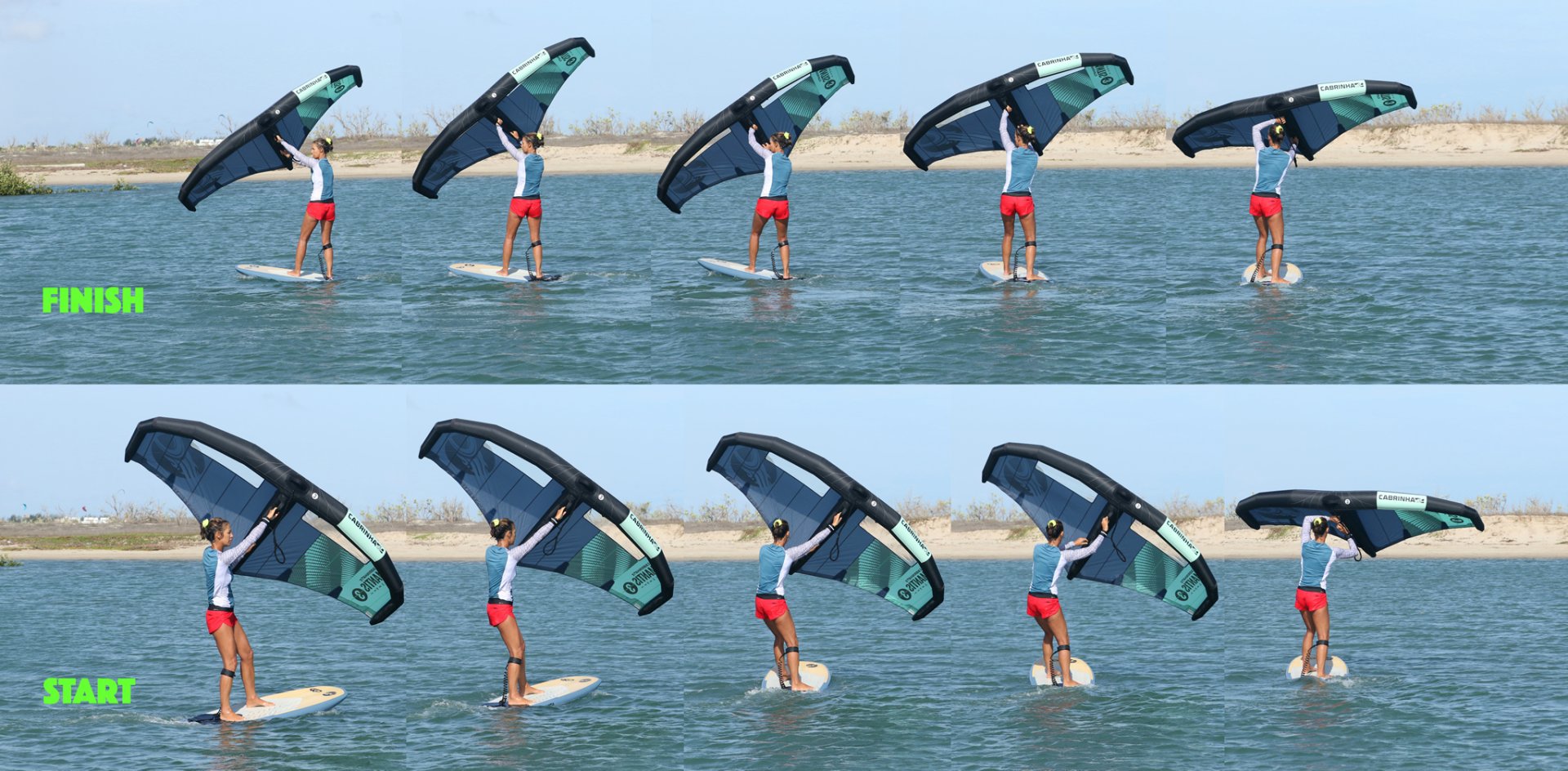
A tack is not a jump. It is a walk.
Your center of mass must travel forward and across the board while staying vertically calm. Sudden height changes translate directly into foil instability.
Critical body mechanics include:
-
Forward hips before turning the board
-
Neutral shoulders relative to mast
-
Eyes leading the rotation, not the wing
These mechanics later become essential for changement de pied wingfoil and aerial transitions like the 360 wingfoil.
Why Most Riders Fail Their First 100 Tacks
Statistically, progression data from coaching clinics and rental centers shows that riders often attempt 80–150 tacks before landing their first fully controlled one. This is not due to lack of talent—it is due to misaligned priorities.
Common failure patterns:
-
Practicing tacks without mastering slow-speed foil control
-
Using oversized wings to “force” the maneuver
-
Switching feet too early (or too late)
-
Riding equipment optimized for speed, not lift
This is where advanced instruction and adaptable equipment setups quietly make a difference. Riders who can tune their foil system—or use assistive propulsion during practice—often compress the learning curve dramatically, especially in marginal wind.

Tack Wing Foil and Its Direct Link to Upwind Performance
The true value of a tack is not aesthetic. It is strategic control.
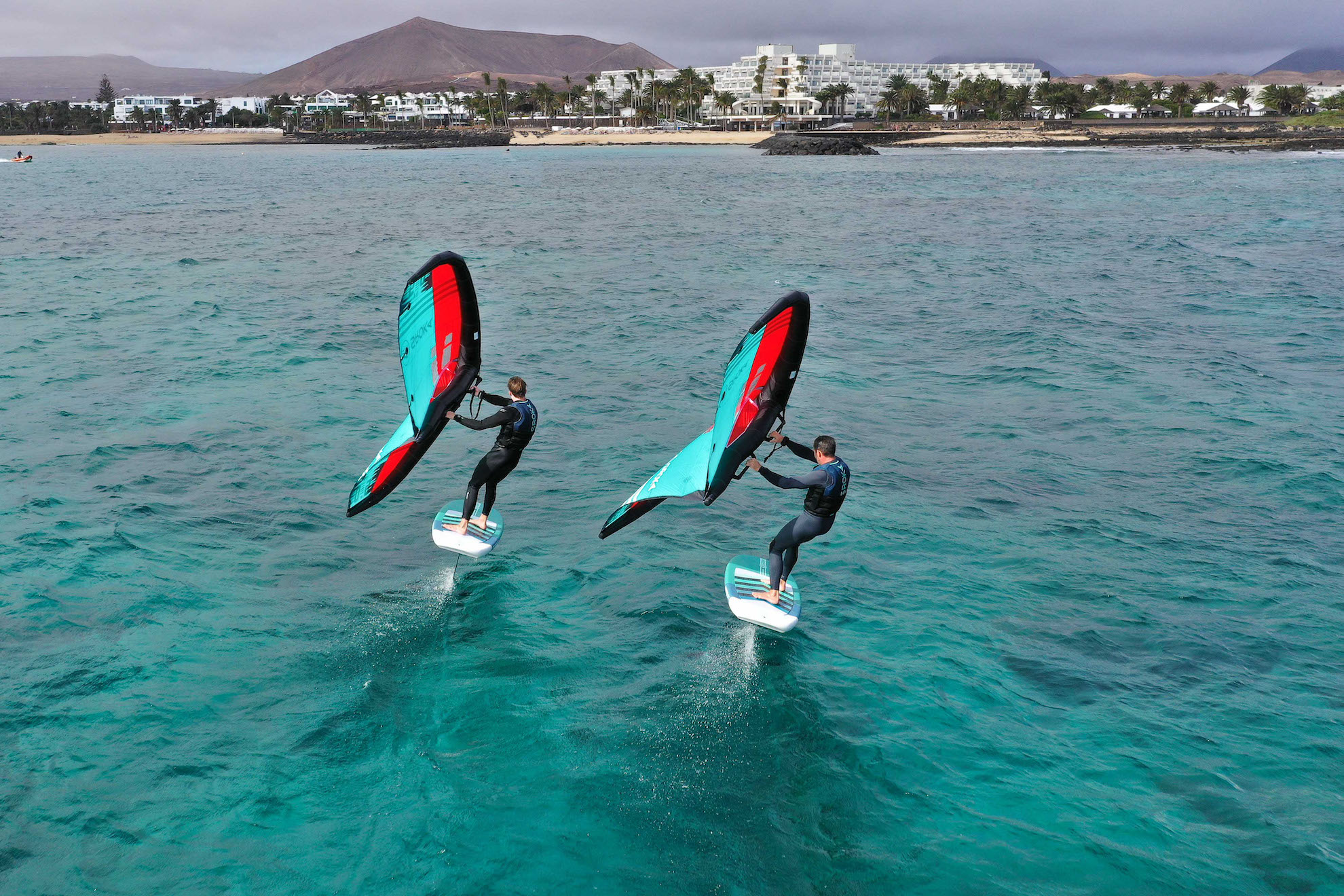
Being able to tack consistently allows you to:
-
Maintain ground position in offshore winds
-
Ride smaller areas without drift
-
Access wave peaks repeatedly
-
Reduce fatigue caused by repeated water starts
This naturally leads to improved remonter au vent wing foil ability. Riders who tack well typically point higher upwind even before the maneuver, because their foil trim and wing handling are more efficient.
In practical terms, this means longer sessions, more usable wind angles, and safer riding margins—factors that directly influence equipment choice and rider confidence.
At this stage, you may understand what makes a tack work—but executing it consistently requires two supporting skills that are often underestimated:
-
Water start wingfoil efficiency, which determines how many quality attempts you get per session
-
Changement de pied wingfoil, which defines stability before, during, and after the maneuver
Why Water Start Wingfoil Determines Your Tack Progression Speed
Most riders underestimate how much water start wingfoil efficiency controls their ability to learn advanced maneuvers.
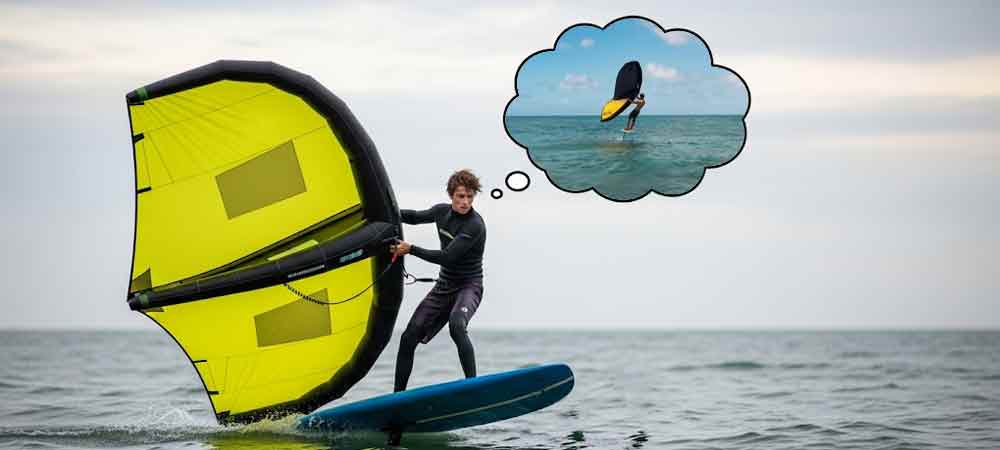
On paper, water start is a beginner skill. In reality, it is a repeatability skill. The faster and more efficiently you can get back on foil after a failed attempt, the more high-quality repetitions you accumulate in a session.
From coaching data and rider logs across multiple learning centers, a clear pattern appears:
-
Riders who require 30–45 seconds per water start average only 20–30 tack attempts per session
-
Riders who water start in 10–15 seconds can attempt 60–80 tacks in the same time window
Skill acquisition is not linear—it is volume-dependent. This makes water start efficiency a force multiplier for tack wing foil learning.
The Three Phases of an Efficient Water Start Wingfoil
An efficient water start is not about strength. It is about sequencing.
Phase 1: Wing Positioning Before Board Movement
Many riders rush to stand up before the wing is doing meaningful work.
Correct sequence:
-
Wing overhead or slightly forward
-
Leading edge angled to create lift, not pull
-
No sudden sheeting
The goal is to let the wing lift your upper body first, reducing load on the board and foil.
Phase 2: Board Alignment and Initial Glide
The board must already be pointed within 10–15 degrees of the desired riding direction before lift-off.
Misaligned boards:
-
Create yaw instability
-
Delay foil engagement
-
Increase stall risk during early acceleration
Advanced riders subtly use small foot pressure shifts to correct board heading before rising onto foil.
Phase 3: Foil Engagement at Minimum Speed
This is where equipment choice silently matters.
Foils that lift smoothly at lower speeds:
-
Reduce failed takeoffs
-
Preserve rider energy
-
Enable more attempts in marginal wind
This is also why many advanced riders—especially heavier or freeride-oriented ones—opt for systems that allow modular foil tuning or temporary propulsion assistance during training. Not to replace skill, but to increase useful repetitions per session.
Why Failed Tacks Expose Weak Water Starts
A failed tack is rarely the real problem. What follows is.
If each failed tack results in:
-
Long water recovery
-
Multiple wing resets
-
High heart rate
…then learning slows dramatically.
Riders who improve their water start wingfoil efficiency often report that their tack success rate increases even before changing technique—simply because fatigue decreases and timing improves.

Changement de Pied Wingfoil: Not a Single Move, But a System
Foot change is often taught as a single action. In reality, changement de pied wingfoil is a timing system that must align with speed, foil height, and wing pressure.
There are two dominant schools of foot change in wing foiling, and confusing them is a major reason riders stall at the tack stage.
System 1: Pre-Tack Foot Change
This method is common among freeride and long-distance riders.
Characteristics:
-
Feet switch before initiating the tack
-
Board remains stable and flat
-
Foil height remains constant
Advantages:
-
Maximum stability during the turn
-
Lower cognitive load mid-tack
-
Ideal for wing foil freeride setups
Requirements:
-
Comfortable riding switch stance briefly
-
Stable foil at moderate speed
-
Calm wing handling
This system integrates well with riders who prioritize remonter au vent wing foil efficiency over stylistic expression.
System 2: Mid-Tack Foot Change
More common in freestyle and wave riding.
Characteristics:
-
Feet switch during the neutral wind moment
-
Requires confident balance with minimal wing load
-
Board trim changes dynamically
Advantages:
-
Faster transitions
-
Direct pathway toward 360 wingfoil and freestyle tricks
-
More adaptable in wave environments
Risks:
-
High failure rate without strong foil control
-
Demands precise timing
Riders attempting this system too early often mistake instability for lack of talent, when the real issue is premature complexity.
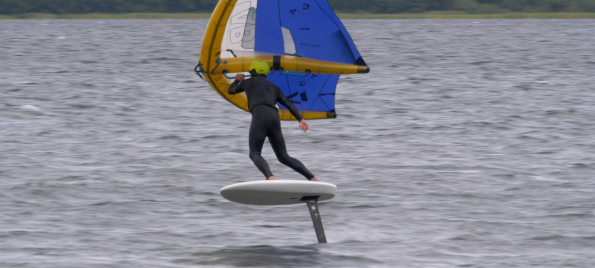
How Foot Change Timing Affects Foil Lift
Every foot movement creates a pressure spike.
If that spike occurs:
-
Before foil stabilization → breach risk
-
During wind loss → stall
-
After wing re-engagement → recovery delay
Advanced riders minimize this by:
-
Sliding rather than stepping
-
Keeping knees flexed
-
Maintaining forward pressure during the switch
This is why foil size, mast position, and stabilizer angle all influence foot change success—even though footwork appears to be a “body-only” skill.
From Changement de Pied to Foil Tack
Once foot changes become quiet and repeatable, something important happens: the tack stops feeling like a survival maneuver and starts feeling like a controlled foil tack.
A foil tack is simply a tack where:
-
Foil height remains consistent
-
Board trim stays neutral
-
Wing movement is minimal
This is the gateway skill that unlocks:
-
High-angle remonter au vent wing foil lines
-
Linking tacks in confined areas
-
Preparing for aerial rotations such as the 360 wingfoil
Equipment as an Enabler, Not a Shortcut
At this stage, experienced riders often reassess their setup—not to go faster, but to gain control margins.
Key considerations include:
-
Foil profiles that tolerate speed variation
-
Board volume that supports neutral trim
-
Systems that allow fine-tuning rather than forcing adaptation
This is where engineering-focused brands quietly become relevant—not as performance hype, but as problem solvers. Modular designs, adaptable drive assistance, and compatibility with existing boards allow riders to progress without rebuilding their entire setup.
The best equipment is the kind that fades into the background while skills move forward.
Remonter au Vent Wing Foil: The True Measure of Control
Many riders believe they are riding upwind—until they compare tracks.
True remonter au vent wing foil performance is not defined by how often you tack, but by how much ground you gain per transition. Riders who master tack wing foil properly often discover that their upwind angle improves before they even initiate the tack.
This is because upwind performance is the cumulative result of three efficiencies working together:
-
Foil efficiency at medium–low speed
-
Wing angle discipline, especially under partial load
-
Board trim stability, allowing sustained high-angle riding
In practical terms, strong upwind riders:
-
Use smaller wing inputs
-
Maintain constant foil height
-
Avoid speed surges before transitions
This efficiency becomes critical in offshore winds, tidal spots, lakes, and wave zones where returning to position is not optional—it is a safety requirement.
Why Tack Quality Directly Impacts Upwind Angle
A poorly executed tack wastes distance.
Each failed or unstable tack:
-
Loses lateral ground
-
Forces extra water start wingfoil cycles
-
Increases fatigue and decision pressure
In contrast, a clean tack wing foil maneuver:
-
Preserves foil lift through the wind eye
-
Maintains forward momentum
-
Allows immediate re-engagement on the new tack
Over a one-hour session, the difference can amount to hundreds of meters of upwind gain—a measurable, not theoretical, advantage.
From Tack Wing Foil to True Foil Tack
At a certain point, the tack stops feeling like a maneuver and starts feeling like a state change.
This is the transition into a foil tack.
A foil tack is defined by:
-
Continuous foil flight
-
Minimal board pitch variation
-
No visible recovery phase after the turn
What changes is not strength or courage, but timing compression:
-
Wing movement becomes smaller
-
Foot pressure becomes subtler
-
Visual focus shifts earlier into the new direction
Riders often describe this phase as when wing foiling becomes “quiet.” Noise—spray, wing flapping, sudden acceleration—disappears.
The Mechanical Link Between Foil Tack and 360 Wingfoil
The 360 wingfoil is often misunderstood as a trick. In reality, it is a continuous foil tack with extended rotation.
Both maneuvers rely on:
-
Stable foil lift at low apparent wind
-
Neutral wing handling during rotation
-
Confident stance switching under minimal load
If a rider struggles with foil tack consistency, the 360 will feel impossible. If the foil tack is solid, the 360 becomes an exercise in rotation timing rather than survival.
This is why advanced coaches often teach:
“Do not train 360s. Train better tacks.”
360 Wingfoil: Control Before Style
A functional 360 wingfoil has three identifiable phases:
-
Entry – controlled speed, moderate foil height
-
Neutral rotation – wing depowered, body rotating around mast
-
Exit – re-powering without height loss
The most common mistake is over-powering the entry. Speed hides instability until the neutral phase, where everything collapses.
Advanced riders aim for:
-
Slightly underpowered entry
-
Smooth, continuous rotation
-
Predictable exit lift
This mindset shift—from force to finesse—is the same one required to master consistent tack wing foil.

Freeride, Wave, or Freestyle: Choosing a Progression Path
At this stage, riders naturally diverge. Not because of skill gaps, but because of intent.
Wing Foil Freeride
Freeride riders prioritize:
-
Efficiency
-
Long sessions
-
Low failure rates
Their tack wing foil focuses on:
-
Pre-tack foot changes
-
Maximum stability
-
Upwind dominance
They benefit most from:
-
Mid-aspect foils
-
Predictable lift curves
-
Equipment that reduces cognitive load
Wingfoil Wave
Wave riders use tacks as positioning tools.
For them:
-
Tack placement matters more than elegance
-
Timing with swell is critical
-
Foot changes must be adaptable
Wave-oriented riders often accept higher failure rates in exchange for responsiveness and maneuverability.
Wingfoil Freestyle
Freestyle riders treat the tack as a gateway.
Their priorities include:
-
Mid-tack foot changes
-
Rotation readiness
-
Quick re-powering
For them, the tack wing foil is not an endpoint—it is the launchpad for 360 wingfoil, switches, and aerial combinations.
How Advanced Riders Think About Equipment at This Level
By the time riders reach consistent tack wing foil and foil tack proficiency, equipment decisions shift.
The question is no longer:
“What makes me ride?”
But:
“What allows me to progress with fewer compromises?”
This is where systems that emphasize:
-
Compatibility across boards
-
Modular tuning
-
Engineering-driven design
Quietly stand out.
Rather than chasing peak performance numbers, experienced riders often look for setups that:
-
Reduce recovery time
-
Expand usable wind range
-
Support experimentation without penalties
This mindset explains why many advanced riders explore assistive or modular solutions—not to replace skill, but to accelerate learning density while preserving feel.
Where Tack Wing Foil Ultimately Leads
Tack wing foil is not just a maneuver. It is a filter.
Riders who pass through it gain:
-
Directional freedom
-
Technical confidence
-
Strategic riding awareness
Those who avoid it often remain speed-dependent and condition-limited.
Mastering the tack changes how you see the wind, the foil, and your own movement. It connects water start wingfoil, changement de pied wingfoil, remonter au vent wing foil, foil tack, and 360 wingfoil into one continuous skill system.
At Asufun we specialize in providing surfers with all things surf gear. Whether you need customization or affordable casual options, we have you covered. Contact us for a free consultation to find the perfect surfing equipment for you.


📞 Tel/Wechat : 13038886712
📞 WhatsApp:+86 15173416661
Online mall : https://asufun.com/
📧 Email: hydrofoildrive@gmail.com
📸 Instagram: https://www.instagram.com/hydrofoildrive/
🌐 URL: https://hydrofoildrive.com

0 comments