
Explore hydrofoil pumping techniques and real pumpfoiling skills for continuous unpowered flight with tips and gear guidance for riders.
In recent years, hydrofoil pumping—sometimes simply called pumpfoiling—has emerged as one of the most rewarding and physically engaging disciplines in all of watersports. Unlike traditional foiling that relies on waves, wind, or engines, hydrofoil pumping harnesses your own body motion and intelligently designed equipment to sustain lift without external propulsion. Whether you’re doing a pump foil water start, mastering pump foil dock start, or cruising long sections in downwind hydrofoil conditions, the fundamentals are deeply rooted in technique, timing, and the right gear.
In this comprehensive guide, we’ll uncover how pumping works from both a scientific and practical perspective, provide real-world tips that separate beginners from competent riders, and help you choose appropriate equipment—even exploring DIY pump foil options if you’re building on a budget.
What Is Hydrofoil Pumping? The Purest Form of Unpowered Flight
Hydrofoil pumping is a form of unpowered hydrofoiling where the rider uses rhythmic board-to-water pressure and body movement to generate and maintain lift. Unlike sail-powered, wake-powered, or electric-assisted foiling, pumpfoiling draws all its energy from subtle shifts of weight, body motion, and the reaction of the hydrofoil wing itself.
This discipline has attracted a passionate following because it’s accessible (no engine or sail required), it sharpens balance and board skill, and it unlocks extended flights across flat or minimal wave conditions that would otherwise be impossible. According to board sports history, this pumping concept evolved from early hydrofoil experimentation and has since become a recognized form of foiling across ocean and lake environments.
The Science Behind Pumping Hydrofoil: What Makes It Work
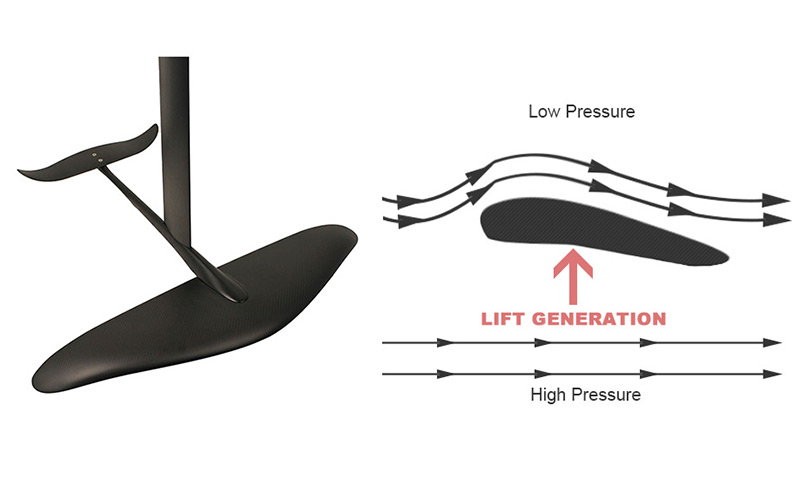
To understand why pumping hydrofoil works, we need to look at how lift is generated and maintained:
Hydrodynamic Lift and Dynamic Motion
A hydrofoil wing generates lift by moving through water at a certain angle and speed. When a rider pumps, they apply pressure to the board with a coordinated sequence of downward push and upward release. The technique temporarily increases the board’s forward speed and the water flow around the foil wing. This causes water to move faster over the top of the foil and slower underneath—creating a pressure differential that maintains lift.
Over time, effective pumpfoiling becomes less about brute motion and more about conserving energy while maximizing sustained lift through optimized motion and timing.
Energy Feedback Loop
What makes hydrofoil pumping unique is the creation of a feedback loop: as you generate lift, drag decreases dramatically, making it easier to sustain flight with lighter input. This is why experienced pumpfoilers can travel long distances with minimal effort compared to the initial bursts required for takeoff.
Pumpfoiling Techniques — From Beginner to Advanced Skills
Pumping is both physically engaging and technically nuanced. Mastering it requires understanding the rhythm, body position, and timing that allow lift to not only occur—but to be sustained.
Basic Pump Cycle
A typical pumping cycle has three phases:
-
Pre-pump Setup:
Your body should be centered over the board with relaxed knees. This initial stance allows you to absorb water reaction without undue strain. -
Downward Pressure:
Push down with a controlled but firm motion through your front foot. This compresses water under the board and increases forward force. -
Upward Release and Glide:
As you release, the board rises slightly, and the foil retains forward momentum. Riders often describe this moment as the “sweet spot,” where lift carries you above the water.
Key Technical Points
-
Never push too aggressively (it increases drag)
-
Focus on fluid transitions—smooth rhythms produce better sustained flight
-
Use your hips and core, not just your legs, to drive movement
Consistency comes from repetition—studies comparing beginner vs advanced pumpfoilers show a direct correlation between smooth pressure transitions and longer foil flights.

Pump Foil Water Start — Getting Rolling in Open Water
The pump foil water start refers to taking off directly from flat, open water without docks, waves, or motor assistance. It’s one of the most quintessential pumpfoiling skills.
Steps and Tips
-
Board Positioning:
The board should sit flat on calm water with the foil just submerged. Too deep means resistance; too shallow means insufficient lift from the wing. -
Initial Glide Attempt:
Start with a strong controlled push to gain flow over the foil. Avoid jerky movements which produce drag spikes. -
Rhythmic Pumping:
Once you feel slight lift, focus on maintaining a smooth sequence of pushes and releases. Aim for continuous motion rather than isolated bursts. -
Balance First, Speed Second:
As counterintuitive as it sounds, maintaining balance helps build speed more efficiently than trying to power forward aggressively.
Common Mistakes to Avoid
-
Looking down at your feet—keep your eyes on the horizon
-
Starting with too small a front wing—bigger wings (e.g., 1800–2400 cm²) help early lift
-
Over-flexing knees—engage core muscles for stability

Pump Foil Dock Start — A Controlled and Progressive Launch Technique
The pump foil dock start is an effective method for riders who want a predictable environment to practice early lifts. By launching from a stable dock or platform, you reduce variables like wind chop or inconsistent water motion.
How It Works
A dock start allows you to begin with slight forward momentum. Pump strokes effectively turn that momentum into lift almost immediately—providing instant feedback on technique and body position.
Advantages
-
Easy to repeat attempts without swimming back
-
Less physical effort to reach initial lift condition
-
Good safety (no waves or current)
Best Practices
-
Start with a gentle push into flat water
-
Keep your start motion low and forward rather than upward
-
Concentrate on balance over speed at first
-
If possible, adjust board angle slightly nose-down to reduce early drag
This method is popular among pumpfoil coaching sessions and clinics because it compresses learning time significantly for new riders.

Beach Start Foil — Combining Shoreline Stability with Technical Lift
For riders who may not have a dock or calm lake available, beach start foil techniques serve as a useful alternative. Launching from shallow shoreline conditions allows you to use your legs to push off and build early momentum.
Strategy and Technique
-
Walk the board into waist-deep water
-
Use forward pressure to initiate glide
-
Once momentum increases, begin gentle pumps
-
Progressively use core and timing to build sustained lift
This approach provides excellent feedback on balance and pressure timing since the shallow bottom gives tactile feedback through the legs.
Tips for Success
-
Keep knees bent but loose
-
Use larger front wings to catch water flow early
-
Gradually build up to deeper water starts once confident
As pumpfoiling skills increase, many riders transition from beach starts to deeper water techniques for longer sustained flights.

Pump Board Water — Choosing the Right Board for Rhythm and Lift
The board you use significantly affects pump board water performance because board design determines how easily you can generate lift and sustain flights.
Key Board Features
-
Volume & Buoyancy: Too little volume makes lift harder; too much slows transitions
-
Length & Width: Shorter boards turn faster; wider boards offer more stability
-
Rocker Curve: Flatter boards accelerate more easily but may nose-dive if too flat
Recommended Sizes for Beginners
Most foam or convertible pump boards range between 5’6” to 7’6” with volume optimized for early stability and controlled lift.
Hard vs Hybrid Boards
-
Rigid Boards: Provide higher energy transfer and are best once you have basic skills
-
Foam / Hybrid Boards: Easier to balance and forgive small mistakes—great for early sessions
Choosing the right board involves balancing early lift, stability, and control. Many riders opt for mid-range boards that let them grow skills without frequent equipment upgrades.

Wing Selection — The Heart of Pumpfoiling Performance
Your foil’s wing design is arguably the most important factor in achieving sustained pumpfoiling.
Wing Characteristics
-
Area (cm²): Larger wings (1800–2400 cm²) create lift easier but slower top speed
-
Aspect Ratio: High aspect foils (longer and narrower) generate less drag and cruise further once lift is achieved
-
Material: Carbon foils are lighter and more responsive but higher cost
Competitive pumpfoiling boards often use high aspect wings that prioritize efficiency over raw speed, enabling riders to conserve energy during long glides.
Choosing the right wing also depends on your weight, water conditions, and riding goals. Never underestimate the efficiency gains from a well-matched front and rear wing pairing.

Mast Height — Stability vs Agility Tradeoffs
The mast connects the board to the foil beneath the surface and its height dramatically affects performance.
-
Short Masts (60–65 cm): Provide stability, easier starts, and lesser leverage; great for beginners
-
Mid Masts (70–80 cm): Balanced choice for progressing skills
-
Tall Masts (90+ cm): Best for advanced riders who want finer glide control and deeper wave riding
Keep in mind that taller masts demand stronger balance but allow earlier lift and cleaner flight in chop.
DIY Pump Foil — Budget Builds and Practical Considerations
Some riders explore DIY pump foil options either for cost savings or experimenting with custom setups. DIY builds often start with:
-
Aluminum or carbon mast blanks
-
CNC-cut wings
-
3D-printed fairings
While DIY can be rewarding, challenges include achieving structural integrity, precise foil geometries, and long-term durability. Commercial foils from specialized brands still tend to outperform homemade builds due to refined designs tested over thousands of hours of water time.
For many riders, even if DIY is considered, pairing a custom foil with a professionally made board yields the best compromise.
Downwind Hydrofoil — Extended Gliding and Pumpfoiling Synergy
While downwind hydrofoil riding typically uses ocean swell energy to maintain lift, proof from competitive foiling and academic studies shows that mastering pumpfoiling substantially improves downwind technique. Downwind conditions often require riders to sustain flight over long distances by adapting their pump rhythm to the swell intervals—turning every minor bump into continuous lift and glide.
This makes downwind riding a nuance-rich dance of balance, anticipation, and foil efficiency—skills that are sharpened dramatically through dedicated pumpfoiling practice.

Common Pumpfoiling Mistakes and How to Fix Them
Even seasoned riders encounter challenges. Here are common pitfalls and fixes:
1. Can’t Take Off
Cause: Poor stance or insufficient forward pressure
Fix: Lower center of gravity and time pressure exactly as you begin movement
2. Speed Drops Mid-Flight
Cause: Over-compensating with large motions
Fix: Smaller rhythmic pumps with core engagement
3. Nose Diving
Cause: Too flat a board or improper timing
Fix: Adjust stance backward slightly and refine pump timing
Real Rider Progression Plan — From Beginner to Competent Pumpfoiler
Here’s a practical 8-week progression plan riders around the world find effective:
Weeks 1–2: Balance and Position
Focus on board balance on calm water
Weeks 3–4: Early Lift Attempts
Practice gentle pumps and small glides
Weeks 5–6: Controlled Lift and Turn
Integrate directional control while sustaining lift
Weeks 7–8: Extended Glide Practice
Aim for longer sequences with minimal effort
By committing to consistent sessions and adjusting technique based on feedback, many riders find they achieve meaningful flight consistency within one summer season.
Product Spotlight — ASUFUN Pump Foil & Foil Assist Gear
As you progress, choosing quality gear becomes essential. ASUFUN offers a range of products that riders frequently select for pumpfoiling progression — particularly when bridging into electric-assisted pump foiling or longer sessions. Their lineup includes:
-
ASUFUN 8kW Electric Hydrofoil Board: A powerful electric-assisted foil board blending responsiveness with long session capabilities, enabling riders to spend more time learning transitions rather than struggling with initial lift.
-
Asufun Foil Board – Full Carbon Fiber Board: A lightweight board ideal for transitioning from beginner boards to high-performance foil practice.
-
ASUFUN Core & Fusion Hydrofoil Assist Batteries: These provide sustained thrust to help riders move from beginners to more consistent flight while retaining unpowered pumpfoil technique practice.

ASUFUN’s products are known for balancing performance and affordability, helping riders explore pumpfoiling deeply without over-paying for premium brand costs.
Final Tips — Training, Safety, Community, and Growth
To succeed in pumpfoiling:
-
Wear appropriate safety gear (impact vests, helmets)
-
Join local groups or clinics for live feedback
-
Record sessions to analyze body mechanics
-
Rest adequately to avoid fatigue
Active communities around pumpfoiling share techniques and help break through early plateaus.
Conclusion
Hydrofoil pumping is as much a science as an art. From mastering body rhythm to choosing the right pump board and wing combinations, sustained unpowered flight is reachable with patience, technique, and the right gear. Whether you stick to pump foil water start, refine dock starts, or explore synergistic downwind hydrofoil sessions, understanding the physics and practicing intentionally will fast-track your progress. Quality gear like ASUFUN’s offerings can help bridge learning gaps and elevate your pumpfoiling experience.

At Asufun we specialize in providing surfers with all things surf gear. Whether you need customization or affordable casual options, we have you covered. Contact us for a free consultation to find the perfect surfing equipment for you.


📞 Tel/Wechat : 13038886712
📞 WhatsApp:+86 15173416661
Online mall : https://asufun.com/
📧 Email: hydrofoildrive@gmail.com
📸 Instagram: https://www.instagram.com/hydrofoildrive/
🌐 URL: https://hydrofoildrive.com

0 comments