
How hydrofoil works explained clearly: learn why hydrofoils fly, how they differ from surfboards, and how hydrofoiling really works.
If you have ever watched someone riding a foil board, you probably felt the same confusion and fascination:
the board seems to float above the water, barely touching the surface, moving smoothly and quietly while traditional surfboards struggle nearby.
This raises a very natural question for beginners:
What exactly is a hydrofoil, and how hydrofoil works so differently from normal surfing?
In this guide, we will break down how a hydrofoil works, step by step, without unnecessary jargon. You will learn why hydrofoiling feels faster, smoother, and more efficient, how it compares to traditional surfing, and why hydrofoils have become one of the fastest-growing segments in modern water sports.
What Is a Hydrofoil, Really?
At its core, a hydrofoil is a wing-shaped structure mounted under a board, designed to generate lift when moving through water.
Instead of sliding on the water’s surface like a traditional surfboard, a hydrofoil board rises above the surface, supported by lift created underwater. This is why people often describe hydrofoiling as “flying over water.”
The key idea is simple:
-
A surfboard relies mostly on buoyancy
-
A hydrofoil relies on hydrodynamic lift
This single difference explains almost everything about why hydrofoils behave so differently.
Hydrofoils are not new. Variations of foils have been used in boats and ships for over a century. What changed recently is materials, precision manufacturing, and foil design, which made foils light, strong, and responsive enough for individual riders.

How Hydrofoil Works Compared to a Normal Surfboard
To truly understand how hydrofoil works, it helps to compare it directly with a traditional surfboard.
Traditional surfboard
A surfboard stays on the surface. As speed increases, it pushes water out of the way, creating drag. More speed usually means more resistance. This is why small or weak waves quickly lose power for regular surfing.
Hydrofoil board (aerofoil board concept)
A hydrofoil behaves more like an aerofoil board, using the same principles as an airplane wing. Once enough speed is reached, the foil generates lift, raising the board above the water and dramatically reducing drag.
When the board is airborne:
-
Water resistance drops sharply
-
Motion becomes smoother and quieter
-
Small waves or even flat water become rideable
This is why many riders describe hydrofoiling as effortless once they are flying.
How a Hydrofoil Works — The Physics Made Simple
Let’s break down how a hydrofoil works in practical terms.
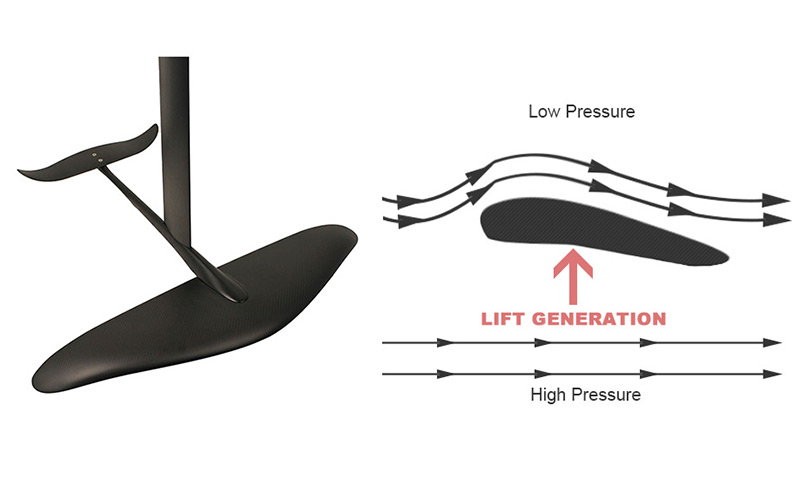
A hydrofoil wing has a curved shape:
-
Water moves faster over the top surface
-
Pressure above the wing drops
-
Higher pressure below pushes the wing upward
This pressure difference creates lift.
Three main factors control lift:
-
Speed – more speed means more lift
-
Wing area – larger wings lift at lower speeds
-
Angle of attack – the angle between the foil and the water flow
Once lift exceeds the combined weight of the rider and board, the system rises above the water.
This principle is exactly the same reason airplanes fly, except water is denser than air, allowing hydrofoils to generate lift at much lower speeds.
This explains why beginners often feel surprised: hydrofoils don’t need extreme speed to fly, just the right speed and setup.
“Hydrofoil Works” Across Languages — Same Physics, Same Curiosity
One interesting SEO insight is that people all over the world ask the same question in different languages:
-
how hydrofoil works
-
how a hydrofoil works
-
hydrofoil works
-
como funciona el hydrofoil
-
wie funktioniert foil surfing
Regardless of language, the curiosity is universal:
Why does this thing fly when others don’t?
The answer is always the same: lift, drag reduction, and efficiency.
Understanding this shared foundation helps beginners realize that hydrofoiling is not magic, nor is it a niche trick — it is a refined application of proven physics.
Why Hydrofoiling Feels Faster and Smoother
Many first-time riders say the same thing after their first successful flight:
“It feels like cheating.”
Hydrofoiling feels fast not because the board is moving dramatically quicker, but because drag is drastically reduced. Studies in marine hydrodynamics show that hydrofoil-supported craft can experience 50–80% less drag compared to displacement or planing hulls at similar speeds.
Less drag means:
-
Less effort to maintain speed
-
Less vibration from chop
-
More glide with less wave energy
This is why hydrofoiling opened doors to disciplines like flatwater foiling, lake riding, and ultra-small wave surfing.

What “Hydrofoiling” Really Means for Riders
The term hydrofoiling doesn’t just describe equipment — it describes a different riding experience.
Hydrofoiling shifts focus from:
-
Fighting waves
to -
Managing balance, height, and efficiency
Riders learn to:
-
Control pitch with subtle weight shifts
-
Read water energy instead of wave faces
-
Maintain flight through smooth, continuous motion
This is why hydrofoiling often feels more technical than traditional surfing, but also more rewarding long-term.
Foils, Foil Parts, and Why Design Matters
A hydrofoil system is made of multiple foil parts, each with a specific role:
-
Front wing – generates most of the lift
-
Rear wing (stabilizer) – controls pitch stability
-
Mast – connects foil to board, defines leverage
-
Fuselage – links wings together
Together, these foils form a balanced system. Small changes in size, angle, or position can dramatically affect how the board feels.
Understanding foil parts is the first step toward real progression, and later sections will explore this in much greater depth.

Why Hydrofoils Changed Water Sports Forever
Hydrofoils didn’t just add a new toy to the water — they redefined efficiency.
By lifting above the surface, hydrofoils allow:
-
Longer rides in weaker conditions
-
Access to new locations (lakes, bays, rivers)
-
Reduced environmental dependency
This efficiency is exactly why hydrofoils later became the foundation for electric surfboards, assist systems, and modern e-foil technology — a topic we will explore in the next part.
From Theory to Reality: How Hydrofoils Are Built and Tuned
Understanding how hydrofoil works at a theoretical level is only half the journey.
What truly determines your riding experience is how a hydrofoil is constructed, assembled, and tuned.
This is where many beginners get lost — not because hydrofoiling is complicated, but because small design choices create big performance differences.
Hydrofoil Construction — More Than Just a Wing Under a Board
Hydrofoil construction is the art of balancing strength, weight, stiffness, and hydrodynamic efficiency.
A complete hydrofoil system typically includes:
-
Front wing
-
Rear stabilizer
-
Mast
-
Fuselage
-
Board connection (plate or tuttle)
Each component must work as a single mechanical and hydrodynamic unit.
Poor alignment or flex in one part can reduce efficiency across the entire system.
Modern hydrofoil construction has evolved rapidly due to advances in:
-
Carbon fiber layup
-
CNC aluminum machining
-
Hydrodynamic simulation (CFD)
This evolution is why today’s foils feel radically different from early prototypes.

Hydrofoil Build vs Mass Production — Why Precision Matters
When people talk about hydrofoil build, they are often referring to two very different approaches:
1. Mass-produced entry-level foils
-
Thicker profiles
-
Higher drag
-
Lower cost
-
Designed for stability over performance
2. Performance-oriented or modular systems
-
Thinner, refined foil profiles
-
Higher stiffness-to-weight ratio
-
Tighter manufacturing tolerances
-
Tunable components
The difference shows immediately on the water.
A well-built hydrofoil lifts more smoothly, maintains speed better, and responds predictably to rider input.
This is why experienced riders often say that upgrading foil quality improves progression faster than upgrading board size.
Fabrication Foil Carbone — Why Carbon Fiber Dominates
Fabrication foil carbone (carbon foil manufacturing) has become the gold standard for high-performance hydrofoils.
Carbon fiber offers:
-
Exceptional stiffness
-
Low weight
-
Precise shape retention under load
Why does this matter?
When a foil flexes:
-
Lift becomes inconsistent
-
Pitch control suffers
-
Energy efficiency drops
Carbon foils maintain their designed profile even under heavy load, which means:
-
Predictable lift
-
Cleaner glide
-
Better feedback to the rider
This is especially important for advanced hydrofoiling disciplines and for systems that integrate propulsion later on.
Hydrofoil Build Quality and Learning Curve
Many beginners assume that a “more forgiving” foil must be low-end.
In reality, well-designed hydrofoils make learning easier, not harder.
Good build quality helps beginners because:
-
Lift engages gradually
-
Stall behavior is predictable
-
Roll stability is higher
This reduces sudden breaches and crashes — one of the biggest fears for first-time hydrofoilers.
A properly built hydrofoil teaches correct technique naturally, rather than forcing riders to fight unstable equipment.

Foils and Foil Parts — How Each Component Shapes Performance
Understanding foils as a system requires looking at how individual foil parts interact.
Front wing
-
Larger wings lift earlier
-
Smaller wings favor speed and efficiency
Rear stabilizer
-
Controls pitch stability
-
Affects turning radius and glide
Fuselage length
-
Longer = more stable
-
Shorter = more responsive
Mast
-
Determines leverage and ride height
-
Influences control in chop and turns
Every change modifies how hydrofoil works under real-world conditions.
Mast Position on Foil Board — Small Adjustment, Huge Impact
One of the most overlooked factors is mast position on foil board.
Moving the mast:
-
Forward → earlier lift, more nose-up tendency
-
Backward → higher speed stability, more control
For beginners, incorrect mast placement often feels like “bad balance” or “unstable foil,” when the real issue is setup, not skill.
This is why experienced riders always adjust mast position before changing wings or boards.

Pie Mastil — Why Foot Placement Matters
The term pie mastil (mast foot position) is commonly used in wind- and foil-related disciplines to describe where rider weight interacts with mast leverage.
Correct pie mastil alignment ensures:
-
Balanced pressure between front and rear foot
-
Reduced fatigue
-
Consistent ride height
Incorrect alignment forces riders to compensate constantly, slowing progression and increasing the risk of overcorrection.
This is one of the reasons hydrofoil coaching often focuses on stance before speed.
Aerofoil Board Concept — Why Boards Feel “Too Small” at First
Many beginners are surprised by how compact an aerofoil board feels compared to traditional surfboards.
This is intentional.
Once flying:
-
Board size matters far less
-
Stability comes from the foil, not surface area
Smaller boards:
-
Reduce swing weight
-
Improve responsiveness
-
Enhance efficiency
This design philosophy is central to modern hydrofoil progression.
Hydrofoil Progression — How Riders Actually Improve
True hydrofoil progression follows a predictable pattern:
-
Understanding lift and balance
-
Learning controlled takeoff
-
Maintaining stable flight
-
Linking turns
-
Riding smaller energy sources
Progression accelerates dramatically when:
-
Equipment is tuned correctly
-
Foil build quality is consistent
-
Setup matches rider weight and goals
This is why many riders plateau on entry-level gear and suddenly progress when switching to a better-matched system.

From Pure Hydrofoiling to Electric Assist: The Natural Evolution
Once you truly understand how hydrofoil works, a surprising realization emerges:
Hydrofoils are already incredibly efficient.
Electricity didn’t change the sport — it simply removed the hardest barrier.
That barrier is not balance, not strength, not even fear.
It is consistent, controllable speed.
How Does Electric Surfboard Work — And Why Hydrofoils Made It Possible
Many beginners ask:
How does electric surfboard work, and how is it different from traditional hydrofoiling?
An electric surfboard system adds a controlled propulsion unit to an already efficient hydrofoil platform. Instead of relying on waves, wind, or towing, the rider uses electric thrust to reach takeoff speed.
What matters most here is this:
-
The motor does not create flight
-
The hydrofoil still creates lift
Electric systems simply provide:
-
Predictable acceleration
-
Repeatable takeoff conditions
-
Continuous practice time
Without hydrofoil efficiency, electric surfboards would be impractical. With hydrofoils, they become elegant.

Manual Hydrofoiling vs Electric Assist — Not a Replacement, a Bridge
A common misconception is that electric hydrofoils replace “real” hydrofoiling.
In practice, the opposite happens.
Electric systems:
-
Accelerate early-stage learning
-
Reduce frustration during takeoff
-
Allow skill repetition without ideal conditions
Riders still need to master:
-
Pitch control
-
Roll stability
-
Height management
-
Turning mechanics
Once these skills are learned, many riders transition seamlessly back to manual hydrofoiling with better technique than wave-only learners.
This is why instructors increasingly use electric assist as a training multiplier, not a shortcut.
Hydrofoiling Efficiency — The Hidden Reason Electric Systems Feel So Smooth
Because hydrofoils reduce drag so dramatically, electric systems can operate at:
-
Lower power output
-
Higher energy efficiency
-
Longer ride times
Compared to traditional electric surfboards that plane on the surface, hydrofoil-based systems consume significantly less energy per kilometer.
This efficiency advantage explains why:
-
Batteries can be smaller
-
Motors can be lighter
-
Control can be more precise
In short: hydrofoils didn’t adapt to electricity — electricity adapted to hydrofoils.
Hydrofoil Progression Revisited — Where Electric Assist Fits
Revisiting hydrofoil progression, electric systems slot in naturally:
-
Beginner: Learn lift, balance, stance without waves
-
Intermediate: Practice turns, height control, transitions
-
Advanced: Train efficiency, glide, downwind techniques
Electric assist does not replace progression — it removes randomness from it.
This is especially valuable for riders who:
-
Live far from consistent waves
-
Ride lakes or flatwater
-
Have limited time per session

From Hydrofoil Construction to Modular Electric Systems
Remember what we discussed earlier about:
-
Hydrofoil construction
-
Foil parts
-
Mast position on foil board
-
Carbon fabrication (fabrication foil carbone)
Electric systems amplify every design decision.
A poorly built foil becomes harder to control with power.
A well-balanced, stiff, modular foil becomes exceptionally intuitive when assisted.
This is where system-level thinking matters more than individual components.
Where ASUFUN Fits — Engineering for Real Progression
ASUFUN does not approach hydrofoiling as a single product.
It approaches it as a progression system.
Across its product lineup, the focus is on:
-
Modular compatibility with existing boards
-
Reliable carbon-based foil structures
-
Electric assist solutions that respect hydrofoil physics
-
Scalability from learning to performance riding
Instead of forcing riders into a closed ecosystem, ASUFUN systems are designed to:
-
Adapt to different foils and boards
-
Support both manual and electric hydrofoiling
-
Grow with the rider’s skill level
This philosophy aligns directly with everything explained in this guide:
efficiency first, control second, power last.
Hydrofoil Works — The Big Picture
So, how hydrofoil works is no longer a mystery:
-
Lift replaces buoyancy
-
Efficiency replaces brute force
-
Design replaces guesswork
Whether you ride waves, wind, flatwater, or electric assist, the foundation is the same.
Once you understand that foundation, choosing equipment becomes logical instead of confusing.
Who Should Consider Electric or Assist Systems?
Electric or assist hydrofoil systems are ideal if you:
-
Want faster, safer progression
-
Lack consistent wave or wind conditions
-
Value efficient engineering over raw power
-
Plan to train technique, not just cruise
They are not a replacement for skill — they are a multiplier.
Final Thought — Learning the Right Way
Hydrofoiling rewards understanding more than strength.
Those who invest time learning how hydrofoil works, how foils interact, and how progression really happens, advance faster and ride longer — regardless of whether they choose manual or electric paths.
At Asufun we specialize in providing surfers with all things surf gear. Whether you need customization or affordable casual options, we have you covered. Contact us for a free consultation to find the perfect surfing equipment for you.


📞 Tel/Wechat : 13038886712
📞 WhatsApp:+86 15173416661
Online mall : https://asufun.com/
📧 Email: hydrofoildrive@gmail.com
📸 Instagram: https://www.instagram.com/hydrofoildrive/
🌐 URL: https://hydrofoildrive.com

0 comments