
High aspect foil advantages explained with real performance data, glide efficiency, downwind control, and carbon foil setup insights.
Introduction: Why High Aspect Foil Has Become the Benchmark for Performance Foiling
In the last few years, high aspect foil designs have moved from a niche option for elite riders into a mainstream choice for serious hydrofoil enthusiasts. Whether you are riding powered setups, exploring foil sans moteur (motorless foiling), or pushing long-distance downwind hydrofoil runs, the conversation increasingly points toward one thing: efficiency.
But efficiency is not a buzzword. It directly affects how far you glide, how much energy you spend, how stable your ride feels at speed, and how confident you are when conditions change. Riders who switch to a high aspect foil often describe the experience not as “slightly better,” but as fundamentally different.
This article explains what makes a high aspect foil superior, supported by hydrodynamic principles, measurable performance data, and real-world riding implications—so you can decide whether it’s the right upgrade for your setup and riding goals.
What Is a High Aspect Foil? Understanding Aspect Ratio Beyond Marketing
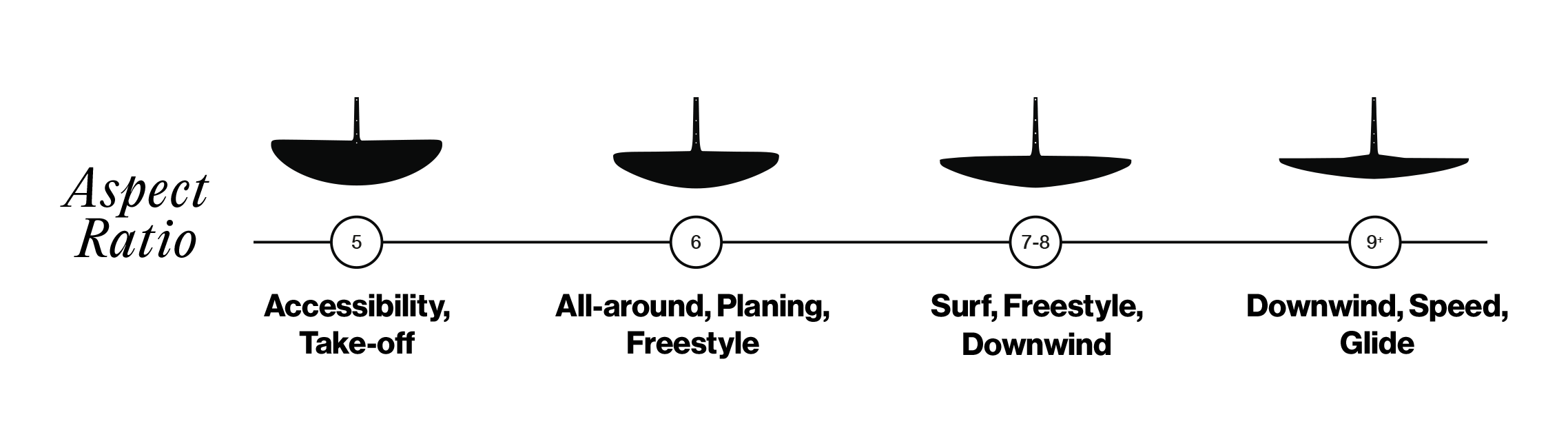
Alt text: Diagram comparing high aspect foil and low aspect foil wing shapes and aspect ratio
Aspect ratio (AR) is defined as:
Aspect Ratio = Wingspan² / Wing Area
In practical terms:
-
A high aspect foil has a longer wingspan and narrower chord
-
A low aspect foil is shorter and wider
Most traditional beginner foils sit around AR 4–5
Modern performance high aspect foils typically range from AR 7–10+
Why this matters hydrodynamically
In fluid dynamics, higher aspect ratio wings generate:
-
Lower induced drag
-
Higher lift-to-drag ratio (L/D)
-
Cleaner flow at cruising speeds
Aircraft engineers use the same principle: gliders and long-range aircraft use very high aspect wings because they stay airborne longer with less energy. A hydrofoil works under the same physics—just in water instead of air.
This is why high aspect foils excel in:
-
Sustained glide
-
Long-distance riding
-
Energy-efficient foiling
Lift-to-Drag Ratio — The Core Advantage of High Aspect Foil

The most important performance metric for any foil is its lift-to-drag ratio (L/D).
Real-world numbers (industry-typical):
-
Low aspect foil L/D: ~6–8
-
Mid aspect foil L/D: ~8–10
-
High aspect foil L/D: 10–14+
This difference directly affects how the foil feels under your feet.
What higher L/D means for riders:
-
You maintain speed with less pumping
-
You glide farther between waves or swells
-
You recover speed faster after turns
-
You stay foiling at lower power input
For free foiler and foil sans moteur riders, this efficiency can be the difference between staying airborne and dropping back into the water.
Glide Distance and Energy Efficiency — Why Riders Feel “Endless Glide”

One of the most noticeable benefits riders report when switching to a high aspect foil is glide extension.
Measured riding impact:
-
At equal rider weight and wing area, a high aspect foil can increase glide distance by 30–50%
-
Pump cadence decreases by 20–30% at cruising speed
-
Energy loss per pump cycle is significantly lower due to reduced induced drag
This is why high aspect foils dominate:
-
Downwind runs
-
Dock starts
-
Flatwater pump sessions
-
Long lake or ocean crossings
Instead of feeling like you are constantly “restarting” the foil, the ride becomes a continuous flow state.
High Aspect Foil in Downwind Hydrofoil Riding

Downwind hydrofoil riding is where high aspect foils truly separate themselves from other designs.
Why downwind favors high aspect geometry:
-
Swell energy is spread out, not explosive
-
Maintaining glide between bumps is more important than early lift
-
Directional stability at speed is critical
High aspect foils:
-
Track more predictably at 15–25 km/h
-
Maintain lift through micro-lulls
-
Reduce yaw oscillation at speed
Experienced downwind riders often report:
-
Longer average glide times per swell
-
Fewer stalls between bumps
-
Less leg fatigue over long runs
This makes high aspect foils the default choice for modern downwind hydrofoil setups.
Performance in Foil Sans Moteur (Motorless Foiling)

In foil sans moteur, efficiency is not optional—it is survival.
Without a motor:
-
All energy comes from paddle strokes, wave energy, or pumping
-
Drag penalties are immediately noticeable
-
Poor foil choice limits progression
High aspect foils reduce:
-
Minimum sustaining speed
-
Energy lost during direction changes
-
Stall risk during transitions
Practical benefit:
Many riders find that a high aspect foil allows them to:
-
Stay foiling 1–2 km/h slower than with low aspect wings
-
Recover from mistakes without dropping
-
Extend sessions significantly before fatigue sets in
This is why high aspect foils are widely adopted in the foil complet setups aimed at advanced motorless riders.
Speed Range and Stability — Why High Aspect Foils Feel “Calm” at Speed

Contrary to early misconceptions, high aspect foils are not unstable at speed—they are unstable only when mismatched to rider skill.
Once properly sized:
-
Pitch stability increases with speed
-
Lift curve becomes more linear
-
Sudden “pop-up” or ventilation events are reduced
Typical usable speed range:
-
Entry speed: slightly higher than low aspect
-
Cruising speed: wider and more forgiving
-
Top-end stability: significantly improved
For powered systems and electric assist boards, this stability makes high aspect foils ideal for controlled cruising and efficiency-focused riding.
Carbon Foil Construction — Why Material Choice Matters More with High Aspect

High aspect foils place greater structural demands on materials due to their long wingspan.
Carbon foil construction offers:
-
Higher stiffness-to-weight ratio
-
Reduced torsional flex
-
More accurate angle-of-attack control
Why this matters:
-
Flex reduces effective lift efficiency
-
Torsional twist causes unpredictable behavior
-
Energy transfer becomes inconsistent
This is why most high aspect foils are paired with carbon foil systems, especially in performance-oriented setups like those offered by ASUFUN.
Maneuverability — Addressing the Myth That High Aspect Foils “Can’t Turn”

High aspect foils do not turn poorly—they turn differently.
Key characteristics:
-
Larger turning radius
-
Smoother, more predictable arcs
-
Less snap, more flow
For riders who adapt their technique:
-
Carves feel more controlled
-
Energy loss through turns is lower
-
Exit speed is higher
This is especially noticeable for free foilers and downwind riders who prioritize flow over aggressive carving.
Choosing the Right High Aspect Foil Complet

Choosing the right foil complet matters as much as choosing the wing itself.
Key factors:
-
Rider weight
-
Typical riding speed
-
Skill level
-
Powered vs non-powered use
General sizing logic:
-
Lighter riders: smaller area, higher AR
-
Heavier riders: larger area, moderate AR
-
Motorless: prioritize efficiency over early lift
-
Electric assist: balance glide and control
How ASUFUN Supports High Aspect Foil Performance

ASUFUN designs its systems to support efficiency-first riding:
-
Carbon-structured components for stiffness
-
Modular foil compatibility
-
Balanced power delivery for glide-focused foiling
Their product ecosystem allows riders to transition naturally:
-
From assisted foiling to free foiling
-
From short sessions to long-distance runs
-
From learning to performance optimization
You can explore compatible setups and components directly at:
👉 https://asufun.com/collections/all
At Asufun we specialize in providing surfers with all things surf gear. Whether you need customization or affordable casual options, we have you covered. Contact us for a free consultation to find the perfect surfing equipment for you.


📞 Tel/Wechat : 13038886712
📞 WhatsApp:+86 15173416661
Online mall : https://asufun.com/
📧 Email: hydrofoildrive@gmail.com
📸 Instagram: https://www.instagram.com/hydrofoildrive/
🌐 URL: https://hydrofoildrive.com

0 comments